
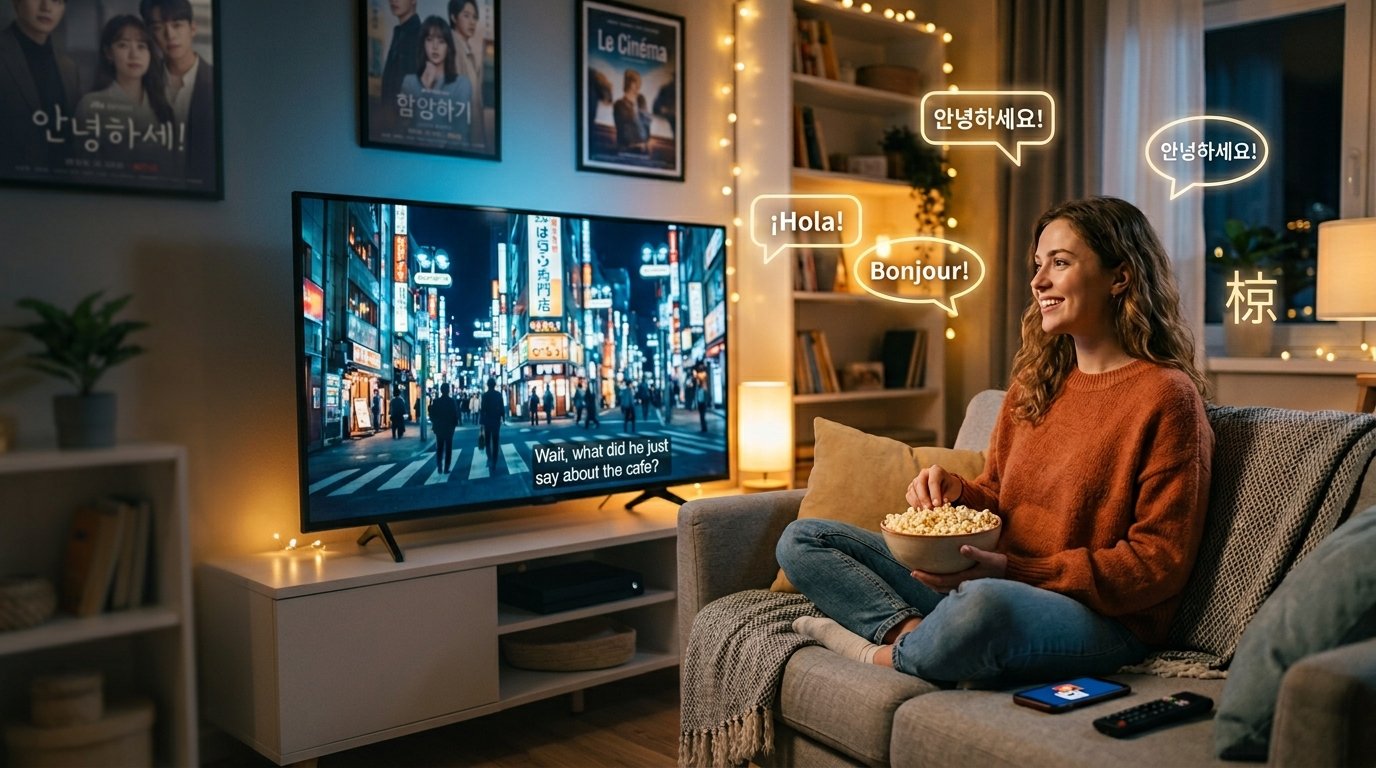
If you’ve ever found yourself watching a Korean drama at midnight, or bingeing a Spanish thriller with subtitles flying across the screen, congratulations. You may already be learning a language without realizing it.

Foreign-language movies and TV shows are now one of the most powerful, underrated tools for language learners. And the best part? You don’t need a classroom, a tutor, or a grammar textbook to get started. You just need a streaming account and the right strategy.
This guide will show you exactly how to use foreign-language content to build real, lasting language skills, even as a complete beginner.
Why Foreign-Language Content Is More Popular Than Ever
The Netflix and Streaming Effect
Ten years ago, watching a foreign-language film meant a trip to an art house cinema or digging through dusty DVD shelves. Today, foreign-language content is front and center on every major streaming platform.
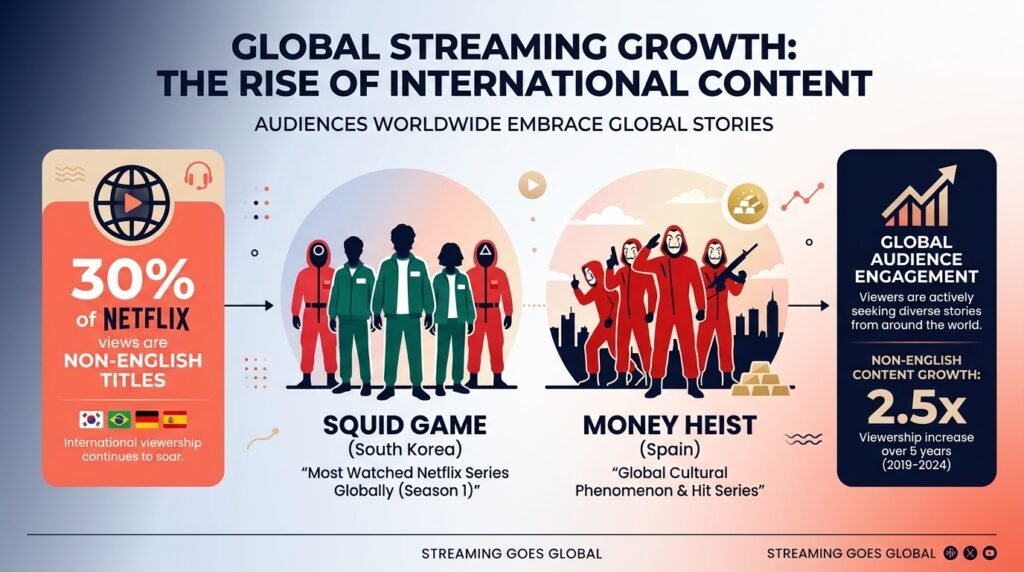
Netflix alone reports that non-English content now accounts for over 30% of total viewing hours globally. Shows like Money Heist (Spain), Squid Game (South Korea), and Dark (Germany) didn’t just become international hits, they became cultural phenomena that sparked conversations in offices, schools, and living rooms worldwide.
This mainstream explosion has done something remarkable: it has normalized watching content in another language. What was once considered niche or “artsy” is now prime-time entertainment.
Why this matters for language learners: The bigger the library of quality foreign-language content, the easier it is to find something you actually want to watch and motivation is the single biggest predictor of language learning success.
Why Subtitles Are Becoming Mainstream
A quiet revolution has happened with subtitles. Surveys show that more than 80% of Gen Z viewers watch TV with subtitles turned on even in their native language. What was once considered an accessibility feature has become a standard viewing preference.
This shift is huge for language learners. Subtitles are no longer stigmatized. They’re expected. That makes it far less intimidating to explore dual-subtitle strategies or to switch between native and target-language subtitles mid-episode.
Streaming platforms have also dramatically improved their subtitle quality and availability. Apple TV+, Netflix, Amazon Prime, and Disney+ now offer high-quality subtitles in dozens of languages across most of their foreign-language catalog.
How Global Entertainment Changed Viewing Habits
The rise of global streaming didn’t just change what people watch, it changed how they think about language and culture. Viewers who fell in love with Squid Game wanted to understand what characters were actually saying beyond the subtitles. Fans of Lupin started picking up French phrases. Narcos had millions Googling basic Spanish vocabulary.
This organic curiosity is exactly the kind of motivation that fuels real language acquisition. Language learning researchers call it “integrative motivation” learning a language not because you have to, but because you genuinely connect with its culture and people.
Foreign movies and TV shows create that connection better than any textbook ever could.
Can You Really Learn a Language by Watching TV Shows?
This is the most common question beginners ask, and the honest answer is: yes, but not in isolation.
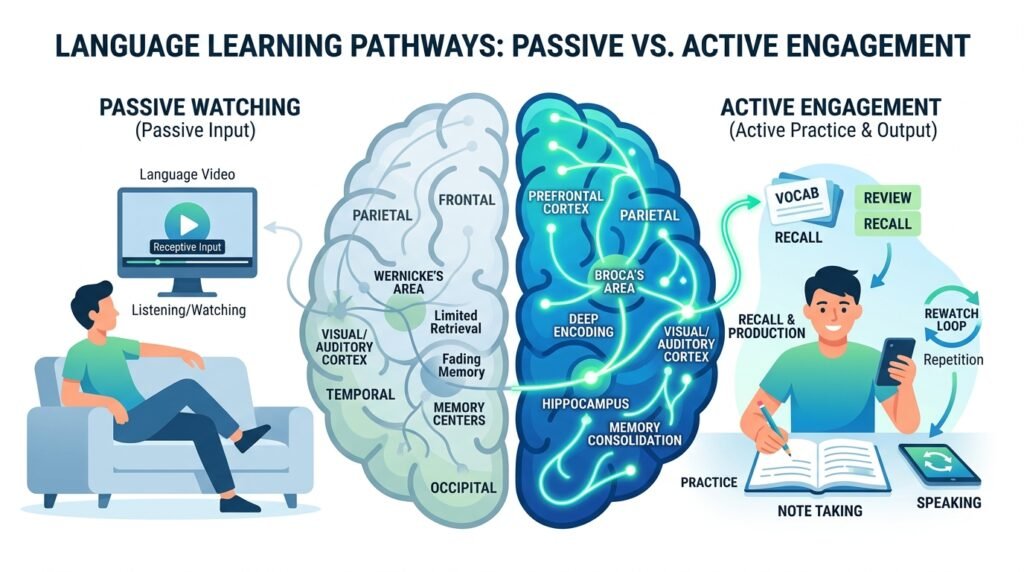
Watching foreign-language content works. Science supports it. But it works best when combined with active engagement strategies rather than purely passive viewing.
What Science Says About Language Immersion
Immersion, surrounding yourself with a language in natural, meaningful contexts, is one of the most effective language learning methods documented in research. Dr. Stephen Krashen’s influential Input Hypothesis suggests that language acquisition happens when learners are exposed to comprehensible input: language that is slightly above their current level but understandable through context.
TV shows and movies are a nearly perfect delivery system for comprehensible input. Visual cues, facial expressions, body language, music, and story context all help the brain decode meaning, even when you don’t understand every word.
The brain also responds differently to emotional content. When you’re engaged in a story laughing at a joke, shocked by a plot twist, rooting for a character, your brain releases dopamine, which strengthens memory consolidation. The vocabulary you pick up during a tense scene in a thriller tends to stick far better than flashcard drilling.
Passive Learning vs. Active Learning
Here’s where many beginners go wrong: they assume that simply watching a lot of foreign-language content will eventually make them fluent. It won’t, at least not efficiently.
Passive learning means watching without deliberate attention letting the sounds wash over you, reading subtitles without engaging with the spoken words. This builds listening exposure and accent familiarity, but it’s slow.
Active learning means deliberately engaging with the content:
- Pausing to repeat phrases out loud
- Writing down new vocabulary
- Looking up words you keep hearing
- Rewatching scenes specifically to catch what you missed
The most effective language learners combine both. Use passive watching for entertainment and exposure. Use active strategies during focused 15–30 minute sessions a few times per week.
Why Context Helps Memory Retention
Traditional language learning isolates words and grammar rules from their natural context. You learn “hola” on a flashcard. You memorize verb conjugations on a worksheet.
TV shows teach language the way children learn it embedded in real situations, real emotions, and real conversations. When you hear the word maldito scream in frustration during a dramatic telenovela scene, you’re unlikely to forget what it means.
Context creates multiple memory pathways: visual, emotional, auditory, and narrative. The more pathways, the stronger the recall.
Best Ways Beginners Should Watch Foreign Movies
Start with Simple Genres
Not all foreign-language content is equally accessible for beginners. Action thrillers with rapid gunfire dialogue and dense criminal slang are not your friend at the start.
The best beginner genres are:
- Sitcoms and comedies slower dialogue, repeated phrases, everyday vocabulary
- Animated shows clear enunciation, simple sentence structures
- Reality TV natural, conversational speech without scripted complexity
- Kids’ shows basic vocabulary, repetition, visual context
- Slow-dialogue dramas emotional scenes with deliberate pacing
Save the political dramas, crime thrillers, and rapid-fire comedies for when you’re at an intermediate level.
Use Subtitles Strategically
Subtitles are a tool not a crutch. The key is using them intentionally based on your learning goal in any given session.
See the full subtitle strategy breakdown in the section below.
Watch Shorter Episodes First
A two-hour foreign film with dense dialogue can be exhausting for a beginner. Start with 20–30 minute episodes instead. Shorter episodes mean less cognitive fatigue, easier rewatch cycles, and faster wins.
Once you build stamina and familiarity with the language’s rhythm, longer content becomes much more manageable.
Repeat Scenes Multiple Times
This is the most underutilized strategy in beginner language learning through TV. Most people watch an episode once and move on. Instead, try this:
- Watch a scene once with native-language subtitles to understand the story.
- Watch it again with target-language subtitles, paying attention to how words are written.
- Watch it a third time with no subtitles, focusing purely on what you can now pick up.
You’ll be surprised how much your comprehension improves on the third pass and how much more confident you feel.
Write Down Repeated Phrases
Keep a small notebook (or a notes app) next to you while watching. When you hear the same phrase more than once, especially across different episodes, write it down. Repeated phrases signal high-frequency, useful vocabulary.
You’re not trying to transcribe the show. You’re building a personal vocabulary list from content you actually care about.
The Best Subtitle Strategy for Language Learning
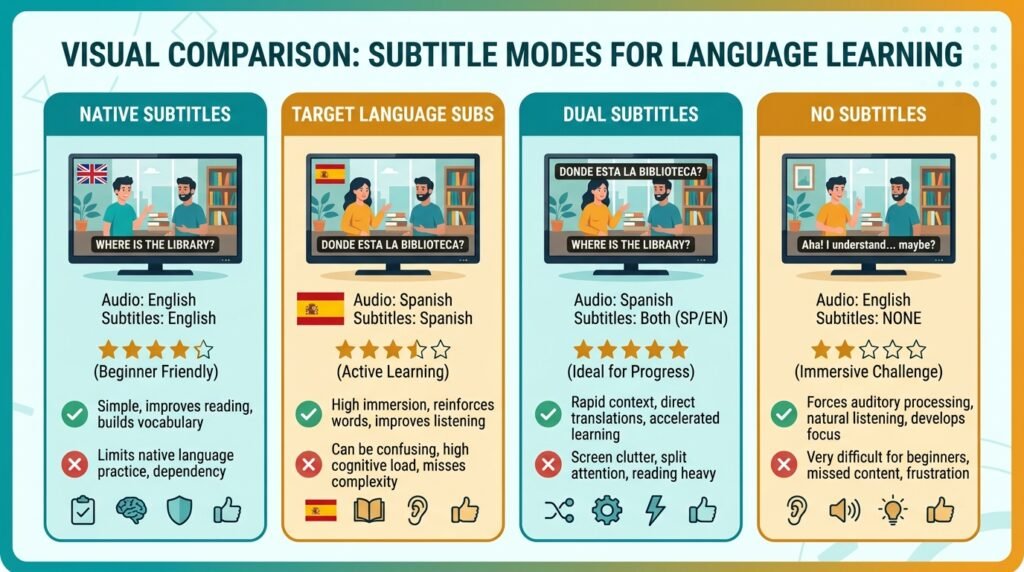
Subtitles are one of the most debated tools in language learning. Here’s a clear breakdown of each approach and when to use it.
| Subtitle Method | Best For | Pros | Cons |
| Native-language subtitles | Absolute beginners | Understand the story fully | May ignore spoken language entirely |
| Target-language subtitles | Intermediate learners | Connect written and spoken forms | Harder to follow if vocabulary is low |
| Dual subtitles | Beginners transitioning up | Best of both worlds | Can feel visually overwhelming |
| No subtitles | Advanced learners | Trains pure listening comprehension | Frustrating too early |
Native-Language Subtitles
If you’re brand new to a language, watching with subtitles in your own language is perfectly fine especially in the first 1–2 weeks. Your goal at this stage is to:
- Get comfortable with the sounds of the language
- Understand story context so you can follow along
- Begin recognizing high-frequency words by ear
Don’t feel guilty about this phase. You’re building a foundation.
Target-Language Subtitles
Once you’ve spent some time with native subtitles and start recognizing a few words, switch to subtitles in your target language. Now you’re connecting what you hear with what you read a critical step for literacy and comprehension.
This is where most of your active learning will happen.
Dual Subtitles
Dual subtitles show both your native language and the target language simultaneously. Tools like Language Reactor (formerly Language Learning with Netflix) make this possible for Netflix content.
This method is especially powerful for intermediate beginners. You get the meaning from your native language subtitle, but your eye is constantly exposed to the target-language version right above it.
Watching Without Subtitles
Watching without any subtitles is the most advanced method and should only be attempted once you can follow the general story without them. It’s a powerful listening exercise, but it can be deeply discouraging if tried too early.
A good rule of thumb: when you understand roughly 50–60% without subtitles, you’re ready to try no-subtitle sessions on familiar content you’ve already watched.
Which Method Works Best for Beginners?
Featured Answer: For complete beginners, start with native-language subtitles for the first two weeks, then transition to dual subtitles using a tool like Language Reactor. Switch to target-language-only subtitles once you recognize 30–40% of common words by sound.
Best Types of Movies and TV Shows for Beginners
Sitcoms
Sitcoms are gold for language learning. Why? Everyday vocabulary. Repeated characters and settings. Predictable social scenarios. And the laugh track (or studio audience) tells you when something’s funny giving you emotional context even when you miss the joke.
Try: Extra en Español (Spanish), Extra en Français (French) these are literally made for language learners.
Animated Shows
Animation is perfect for beginners because voice actors enunciate clearly, dialogue tends to be simpler, and the visual world provides rich context for every word.
Don’t overlook Studio Ghibli films for Japanese learners; the language is beautiful, poetic, and paced deliberately. For Spanish, Peppa Pig in Spanish is surprisingly effective for building a foundation.
Reality TV
Reality TV might feel like a guilty pleasure, but linguistically it’s incredibly valuable. People speak naturally, use colloquial expressions, argue, laugh, gossip all in real conversational language rather than scripted dialogue.
Shows like MasterChef in various languages expose you to clear enunciation (hosts speaking to cameras) as well as casual speech.
Kids’ Shows
Kids’ content is engineered to be understood by minds still acquiring language which makes it perfect for language learners at any age. Simple sentence structures, heavy repetition, and constant visual reinforcement of vocabulary.
Netflix’s library of dubbed children’s content in dozens of languages is one of the most underrated language learning resources available.
Slow-Dialogue Dramas
Some dramatic productions pace their dialogue deliberately, particularly period dramas, literary adaptations, and prestige productions. This slower cadence gives your brain more time to process what you’re hearing.
Look for dramas rather than thrillers, and slower-paced romance over rapid comedies.
Best Foreign TV Shows and Movies to Start With
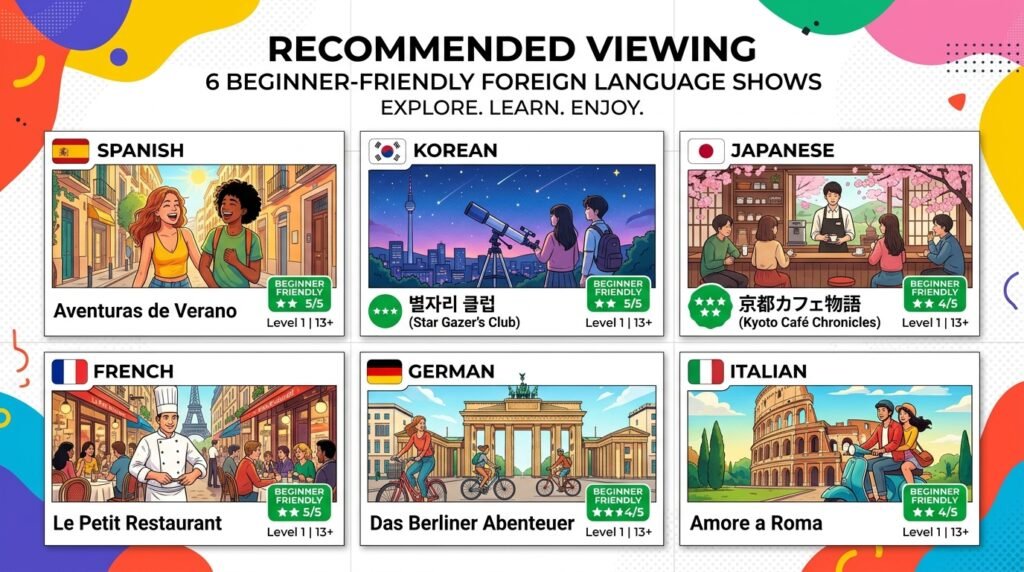
Best Spanish Shows
- Money Heist (La Casa de Papel) Netflix. Intense but excellent for intermediate learners. Madrid Spanish with clear dialogue.
- Elite Netflix. Teenage drama set in a Madrid school. Modern, everyday Spanish.
- Club de Cuervos Netflix. Mexican Spanish. Sports drama with natural conversation.
- Extra en Español YouTube. Made specifically for beginners. Essential first stop.
Best Korean Dramas
- My Love from the Star Hulu/various. Classic romance drama. Clear dialogue, emotional scenes.
- Reply 1988 Netflix. Nostalgic family drama. Slow-paced, excellent for beginners.
- Crash Landing on You Netflix. Romance drama with high production value and clear pronunciation.
- Squid Game Netflix. Not for beginners linguistically, but the cultural exposure is valuable.
Best Japanese Anime
- Shirokuma Cafe YouTube/Crunchyroll. Slice-of-life anime with very simple, repetitive Japanese. Best beginner anime available.
- My Neighbor Totoro Studio Ghibli. Beautiful language, slow pace, ideal for beginners.
- Terrace House Netflix. Reality show with natural Japanese conversation. Excellent for intermediate learners.
- Doraemon Various platforms. Classic anime with everyday vocabulary and clear enunciation.
Best French Films and Shows
- Lupin Netflix. Modern thriller. Parisian French. Intermediate-friendly.
- Call My Agent (Dix pour cent) Netflix. Comedy-drama. Witty dialogue, excellent for intermediate learners.
- Les Choristes Film. Gentle pace, emotional story, beautiful French.
- Miraculous Ladybug Netflix. Animated. Perfect for absolute beginners.
Best German Series
- Dark Netflix. Complex sci-fi thriller. NOT for beginners, but cultural exposure is unmatched.
- How to Sell Drugs Online (Fast) Netflix. Modern comedy-drama. Younger, colloquial German.
- Babylon Berlin Netflix. Historical drama. Slower pacing, excellent diction.
- Bibi Blocksberg YouTube. Children’s content. Ideal starting point for beginners.
Common Mistakes Beginners Make
Trying Advanced Content Too Early
Starting with Dark when you know zero German is a recipe for frustration. The complexity of the plot plus unfamiliar language creates cognitive overload. Choose content that’s linguistically simple even if it’s not your favourite genre.
Watching Passively
Sitting back and letting episodes play back-to-back without any active engagement is the most common mistake. You’ll recognize more and more over time, but you won’t reach conversational ability. Pair passive watching with at least a few active sessions per week.
Using Incorrect Subtitles
Be careful with auto-generated subtitles on YouTube; they’re often inaccurate, especially for non-English content. Use officially translated subtitles wherever possible. Incorrect subtitles create false associations that are difficult to unlearn.
Expecting Fluency Quickly
Language learning through the media is powerful, but it’s not fast, at least not in the way people expect. You won’t wake up fluent after 30 days of Netflix. What you will develop: better listening comprehension, a larger passive vocabulary, and a feel for the language’s rhythm and music. Those are the building blocks of fluency.
Set realistic expectations: 3–6 months of consistent practice before you feel genuinely comfortable following dialogue without subtitles.
How AI Tools Make Language Learning Easier
The AI era has unlocked a new generation of language learning tools that complement your media watching beautifully.
Using AI Subtitles
AI-generated subtitles have improved dramatically. Tools like Whisper (OpenAI’s transcription model) now produce remarkably accurate real-time captions in dozens of languages. Several browser extensions use this technology to add high-accuracy subtitles to streaming content that would otherwise have limited caption options.
Using ChatGPT to Practice Vocabulary
After watching an episode, paste the words or phrases you noted into ChatGPT and ask it to:
- Explain the meaning in context
- Show you example sentences
- Tell you similar phrases at your level
- Quiz you on what you learned
This turns passive vocabulary collection into an active review session all without leaving your browser.
Language Reactor Walkthrough
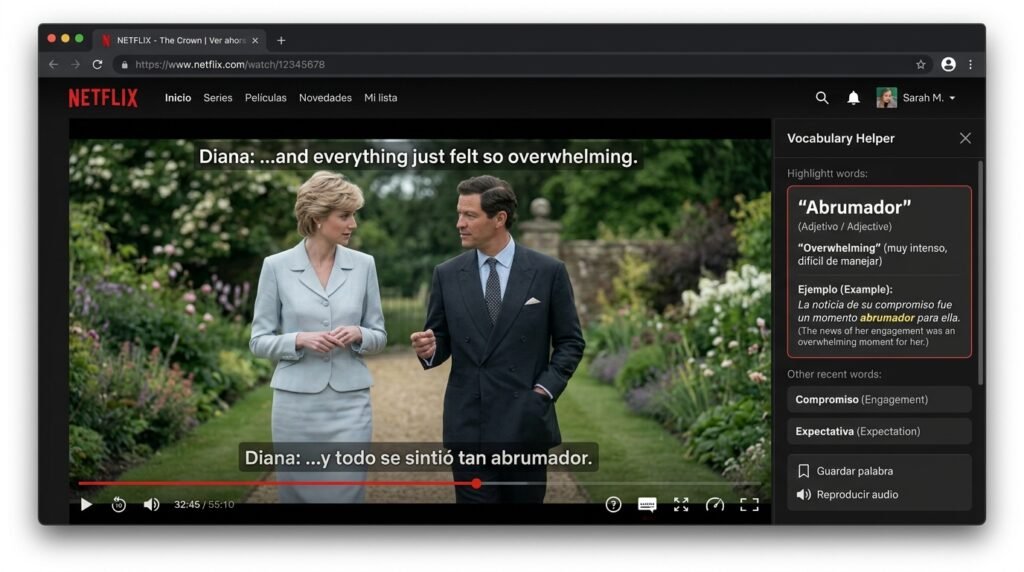
Language Reactor (formerly Language Learning with Netflix) is the single most useful tool for learners who stream.
Here’s how to use it:
- Install the Language Reactor browser extension (Chrome).
- Open any Netflix or YouTube video in your target language.
- The extension automatically displays dual subtitles: your native language above, target language below.
- Click any word in the subtitle to instantly see its translation, pronunciation, and example sentences.
- Save words to your built-in flashcard deck.
- Use the “Subs2SRS” feature to export subtitle lines as vocabulary cards for Anki review.
It’s free for basic features, with a premium tier for advanced vocabulary tools.
AI Dubbing and Translations
Several platforms now offer AI-generated dubbing that matches lip movements and preserves the original actor’s vocal tone. While controversial among purists, AI dubbing has made foreign-language content more accessible to people who find subtitles cognitively demanding.
For language learners, AI dubbing in your native language over foreign-language shows is less useful. But dubbing into your target language over English content you already know can be an excellent listening exercise. You understand the story, so you can focus purely on the language.
30-Day Beginner Plan for Learning Through TV Shows
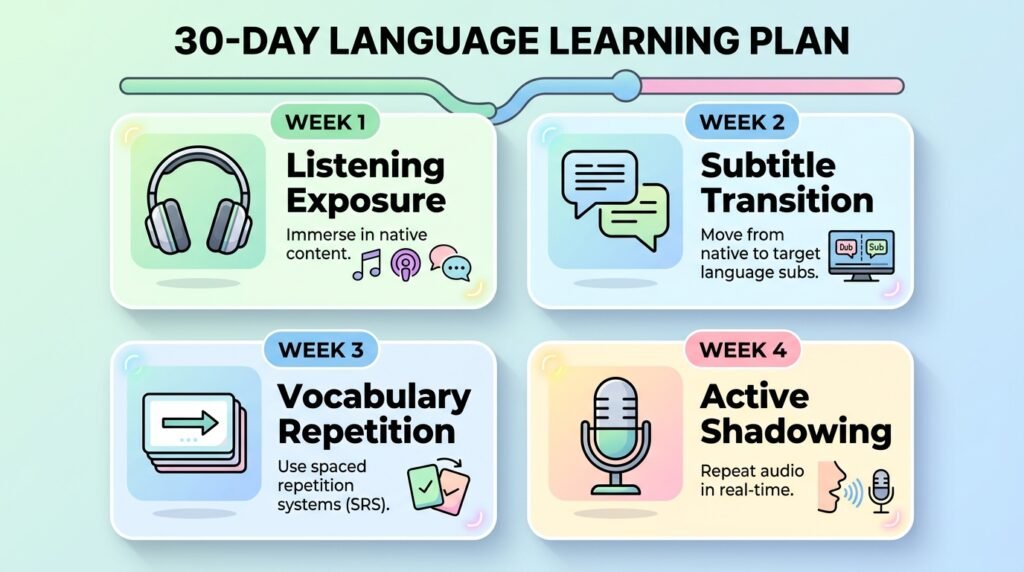
Use this progressive plan to build real language skills in your first month. Consistency beats intensity every time.
Week 1: Listening Exposure
Goal: Get comfortable with the sounds, rhythm, and melody of the language.
- Watch 20–30 minutes of content daily in your target language.
- Use native-language subtitles. Don’t stress about understanding the spoken words.
- Choose a sitcom, animated show, or kids’ content with clear dialogue.
- Pay attention to intonation and emotional tone, not vocabulary.
- Optional: Start with a beginner-designed show like Extra en Español.
Milestone: By the end of Week 1, you should recognize a handful of repeated words or phrases without needing subtitles.
Week 2: Subtitle Transition
Goal: Begin connecting what you hear with what you read.
- Switch to dual subtitles (use Language Reactor on Netflix/YouTube).
- Continue 20–30 minutes daily, but now pause when you see a word appear multiple times.
- Write down 3–5 words per session in a vocabulary notebook.
- Rewatch 1–2 scenes per episode after first viewing.
Milestone: By the end of Week 2, you should recognize 10–20 common words by sound alone.
Week 3: Vocabulary Repetition
Goal: Lock in high-frequency vocabulary through active review.
- Continue dual subtitles, now actively looking up phrases you keep hearing.
- Use ChatGPT or Google Translate to understand grammar patterns in phrases you collect.
- Start a simple Anki deck with your collected vocabulary. Review for 10 minutes daily.
- Try switching to target-language-only subtitles for 5–10 minutes of a familiar scene.
Milestone: By the end of Week 3, you should understand 15–25% of dialogue without reading subtitles.
Week 4: Active Shadowing
Goal: Begin developing your speaking muscles alongside listening comprehension.
- Introduce shadowing: pause a scene, listen to a short phrase, then repeat it out loud matching the speaker’s rhythm, tone, and speed.
- Shadow 5–10 sentences per session. Don’t worry about perfect pronunciation.
- Try a full scene with no subtitles at the end of the week pick something you’ve already watched.
- Reward yourself with an episode purely for entertainment, no studying.
Milestone: By the end of Week 4, you should feel noticeably more comfortable with the language’s sound patterns, and recognize key phrases in real time.
Benefits Beyond Language Learning
Cultural Understanding
Language and culture are inseparable. When you watch a Korean drama, you’re not just learning vocabulary, you’re absorbing the social dynamics of Korean society, family structures, workplace culture, and interpersonal norms. This cultural fluency makes language learning richer and more meaningful.
Many learners report that understanding the culture through media made them want to learn the language more deeply which creates a self-sustaining cycle of motivation.
Accent Familiarity
Every language has dozens of regional accents and dialects. The more varied content you watch, the more your ear adjusts to natural variation. A Spanish learner who has only studied Castilian Spanish may struggle to understand Mexican, Colombian, or Argentine speakers at first but watching diverse content closes that gap naturally.
Improved Listening Speed
Native speakers talk fast. Much faster than any textbook exercise will prepare you for. Regular exposure to native-speed dialogue gradually recalibrates your auditory processing speed. Over months, you’ll find yourself following conversations that once seemed impossibly fast.
Entertainment Motivation
Here’s the secret most language learning apps don’t want you to know: the #1 reason people quit learning a language is boredom. Textbooks and apps demand willpower. TV shows demand nothing if you want to watch the next episode.
When your language learning tool is something you genuinely enjoy, the discipline problem largely disappears. You’re not forcing yourself to study. You’re choosing to be entertained, and picking up a language on the way.
Frequently Asked Questions
Can watching Netflix help you learn a language?
Yes Netflix is one of the best language learning tools available, especially when combined with extensions like Language Reactor. It provides access to native-speed dialogue, dual subtitles, and a massive library of foreign-language content across multiple proficiency levels.
Are subtitles helpful for beginners?
Absolutely. For beginners, native-language subtitles help you understand context while your ear adjusts to the sounds of a new language. Transition to dual subtitles or target-language subtitles as your vocabulary grows. Subtitles are a learning tool, not a shortcut.
How long does it take to learn through movies?
Most learners notice meaningful improvement in listening comprehension after 3–6 months of consistent daily watching (20–30 minutes) combined with active vocabulary review. Fluency through media alone takes significantly longer but it’s a sustainable complement to other learning methods.
Should I watch dubbed or subtitled content?
For language learning, subtitled content in your target language is almost always more effective than dubbed content. Dubbing removes the authentic sounds of the language. Exception: watching English content dubbed into your target language can be a useful exercise once you’re at a low-intermediate level.
What are the easiest foreign TV shows for beginners?
For Spanish: Extra en Español. For Japanese: Shirokuma Cafe. For French: Miraculous Ladybug. For Korean: Reply 1988. For German: Bibi Blocksberg. All feature clear dialogue, simple vocabulary, and strong visual context.
Can children learn languages through cartoons?
Yes and research strongly supports it. Children’s brains are highly receptive to language acquisition through media, especially when content is engaging and repetitive. For adult learners, children’s cartoons in a target language are equally effective as foundational listening practice.
Is passive watching effective?
Passive watching builds listening familiarity and accent recognition over time, but it’s much slower than active engagement strategies like note-taking, shadowing, and scene rewatching. Use passive watching for motivation and exposure, but pair it with active techniques for real language growth.
Which streaming platform is best for foreign-language content?
Netflix has the largest and most diverse library of foreign-language originals with strong subtitle support. Amazon Prime Video and Apple TV+ have excellent selections of international films and series. For Asian content specifically, Viki is purpose-built for Korean, Chinese, and Japanese content with community-sourced subtitles in dozens of languages.
The Bottom Line
Foreign movies and TV shows aren’t a magic shortcut to fluency but they’re one of the most powerful, enjoyable, and sustainable tools available to language learners at every level.
The key is showing up consistently, using subtitles strategically, and treating every episode as both entertainment and a classroom. Whether you’re picking up Korean through Crash Landing on You, French through Lupin, or Spanish through Money Heist, the content you love is already teaching you more than you realize.
Starting tonight. Pick a show from the list above. Turn on the subtitles. And let the story do the work.
Want to go deeper? Explore our guides on the best Netflix shows for language learners, how comprehensible input works, and the best AI tools for language learning in 2026.