


Artificial intelligence is everywhere right now. It writes emails, recommends your next Netflix show, powers your phone’s camera, and is reshaping entire industries overnight.
But for most people, AI still feels like a mystery wrapped in technical jargon.
This guide changes that. Whether you have zero technical background or just want to finally understand what everyone is talking about, you will find clear, honest answers here with no computer science degree required.
By the end, you will know exactly what AI is, how it works, which tools are worth trying today, and what the future actually looks like for people like you.
Let’s start from the very beginning.
What Is Artificial Intelligence?
Simple Definition
Artificial intelligence is the ability of a computer or machine to perform tasks that normally require human thinking.
That includes things like understanding language, recognising faces, making decisions, solving problems, and learning from experience. When a machine can do any of these things on its own without being told exactly what to do at every step, that is artificial intelligence at work.
A simple way to think about it: AI is software that learns, rather than software that just follows fixed instructions.
AI vs Human Intelligence
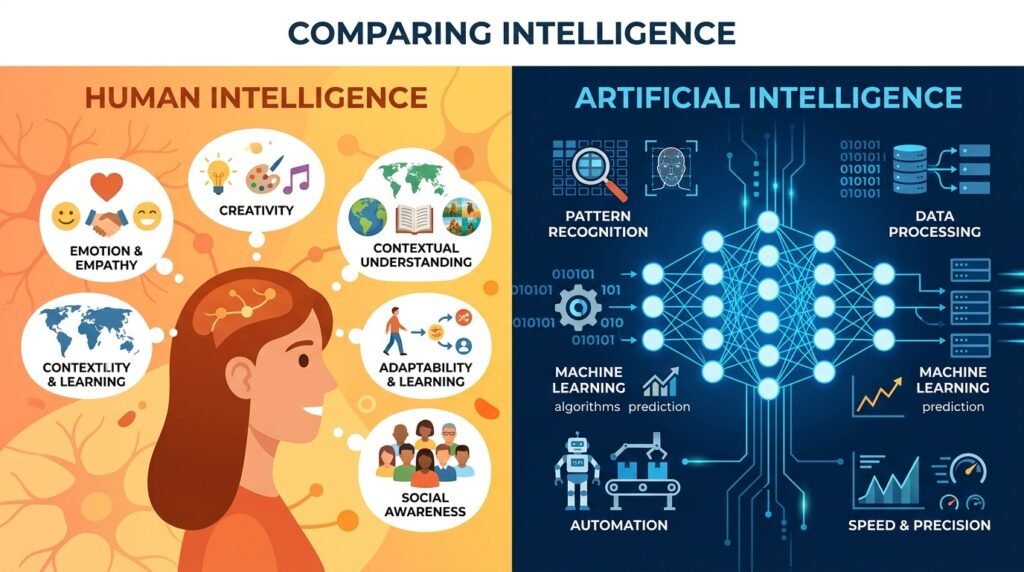
Human intelligence is flexible, emotional, and powered by lived experience. We learn from a handful of examples, understand context instinctively, and apply knowledge across wildly different situations without being explicitly taught.
AI works differently. It learns by processing enormous amounts of data, millions of examples , and finding patterns within that data. It can become extremely good at specific tasks, often surpassing human performance. But it lacks common sense, genuine understanding, and the ability to transfer knowledge the way humans naturally do.
The key difference: humans understand the world. AI recognises patterns within it.
Brief History of AI
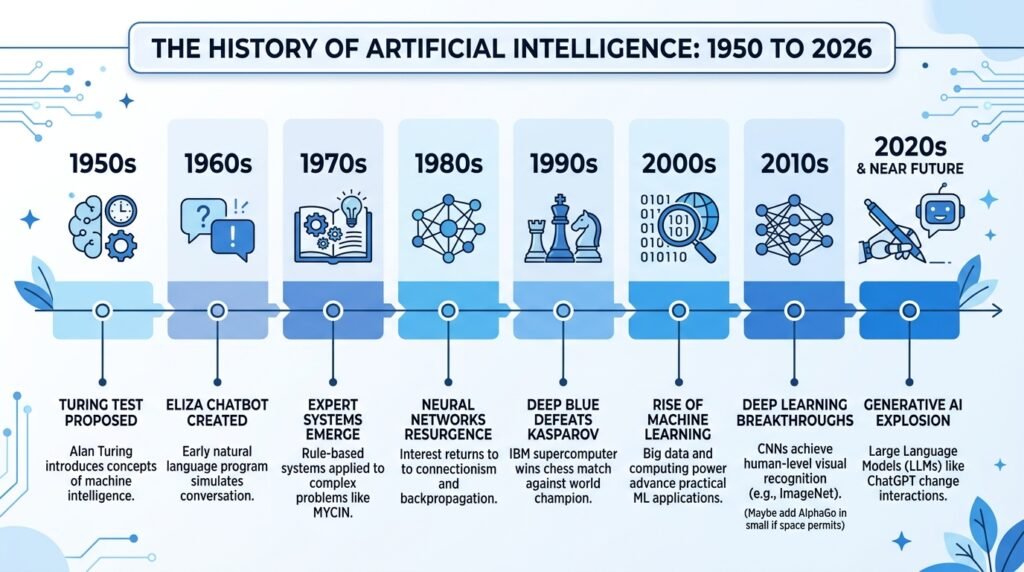
AI is not as new as it feels. Here is a quick timeline of how we got here:
1950s:Alan Turing proposes the famous “Turing Test,” asking whether a machine can think. The term “artificial intelligence” was coined at a Dartmouth College conference in 1956.
1980s: “Expert systems” emerge programs that mimic human decision-making in narrow domains like medical diagnosis.
1990s–2000s: Machine learning takes over from rule-based systems. IBM’s Deep Blue defeats world chess champion Garry Kasparov in 1997.
2010s: Deep learning breakthroughs transform AI. Voice assistants like Siri and Alexa enter everyday life. Self-driving car research accelerates.
2020s: Generative AI explodes into mainstream awareness. ChatGPT reaches 100 million users in two months, the fastest adoption of any technology in history. AI agents begin automating complex multi-step tasks. Governments worldwide begin regulating AI for the first time.
How Does AI Work?
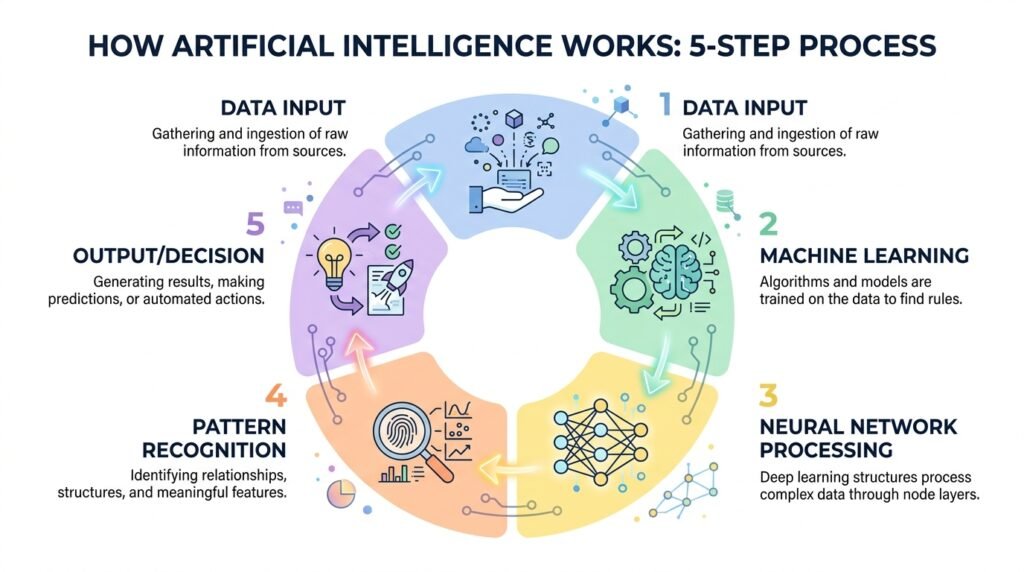
Understanding how AI works does not require a math degree. Here are the five core concepts, each explained in plain English.
Machine Learning
Machine learning is the foundation of modern AI. Instead of programming a computer with explicit rules, you feed it large amounts of data and let it find the patterns on its own.
Think of it like teaching a child to recognise dogs. You do not list every characteristic of every dog breed. You show them hundreds of photos of dogs and not-dogs, and eventually they figure it out. Machine learning works the same way, at a massive scale.
Deep Learning
Deep learning is a more advanced form of machine learning that uses layered algorithms called neural networks to analyse data with extraordinary depth.
If machine learning is like learning to recognise dogs from photos, deep learning is like understanding the relationship between a dog’s breed, its behaviour, its habitat, and its role in human culture, all at once.
Deep learning powers most of the impressive AI breakthroughs you have seen in the last decade: image recognition, real-time translation, voice assistants, and more.
Neural Networks
Neural networks are the architecture behind deep learning. They are loosely inspired by the human brain, layers of interconnected “nodes” that pass information between each other, each layer refining the understanding of the data.
The first layer might recognize basic shapes. The next identifies features. The next recognizes objects. By the final layer, the network can identify a specific face in a crowd with remarkable accuracy.
Generative AI
Generative AI is the technology behind tools like ChatGPT, Google Gemini, Claude, and Midjourney. Instead of just analyzing data, it creates new content, text, images, audio, video, and code, based on patterns learned from training data.
When you ask ChatGPT to write a cover letter or ask Midjourney to create an image, you are using generative AI. It does not copy existing content, it generates something new by predicting what should come next, word by word or pixel by pixel.
AI Agents
AI agents are the next evolution beyond chatbots. While a chatbot answers questions, an AI agent takes actions, browsing the web, writing and executing code, booking appointments, sending emails, and completing multi-step tasks with minimal human input.
In 2026, AI agents are one of the most transformative developments in the field. Companies are deploying agents that handle customer service, manage workflows, conduct research, and operate software on behalf of users. This is where AI shifts from a tool you use to a system that works for you.
Types of Artificial Intelligence
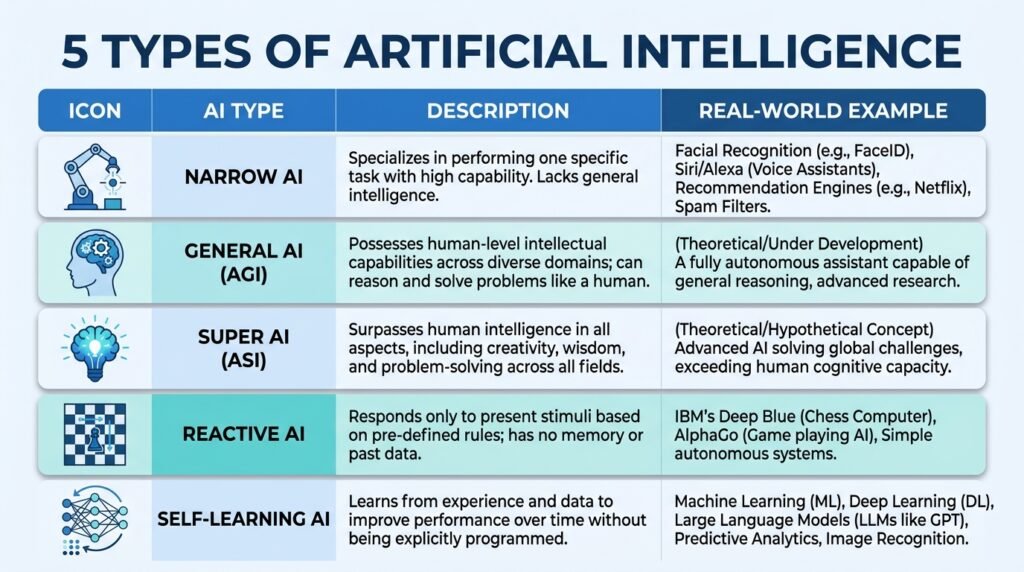
Not all AI is the same. Here is a clear breakdown of the main types and what they mean in practice.
| AI Type | What It Does | Real Example |
| Narrow AI | Excels at one specific task | Spotify recommendations |
| General AI | Matches human intelligence across all tasks | Does not exist yet |
| Super AI | Surpasses human intelligence in every area | Theoretical only |
| Reactive AI | Responds to inputs, no memory or learning | Chess-playing computers |
| Self-Learning AI | Improves automatically from new data | Fraud detection systems |
Narrow AI
This is the only type of AI that actually exists today. Every AI product you can use right now, ChatGPT, Google Translate,facial recognition, recommendation engines is narrow AI. It is extremely good at one specific thing but cannot transfer that ability to unrelated tasks.
General AI (AGI)
Artificial General Intelligence would match human-level intelligence across all domains. It would understand context, transfer knowledge, and reason about new situations the way humans do. Despite enormous investment, AGI does not exist yet. Most researchers believe it remains years or decades away, and debate whether it is even achievable.
Super AI
Super AI would surpass human intelligence in every area simultaneously. This is a theoretical concept at this point, not a near-term reality. It features heavily in AI ethics discussions and long-term risk assessments from organisations like OpenAI and DeepMind.
Reactive AI
Reactive AI responds to current inputs without memory or the ability to learn over time. IBM’s Deep Blue, the chess computer that defeated Garry Kasparo, is a classic example. It could analyse a chess position brilliantly but had no awareness of anything outside that board.
Self-Learning AI
Self-learning AI improves automatically as it encounters new data, without being explicitly reprogrammed. Modern recommendation engines, fraud detection systems, and language models all fall into this category. The more data they process, the better they become.
Real-Life Examples of AI
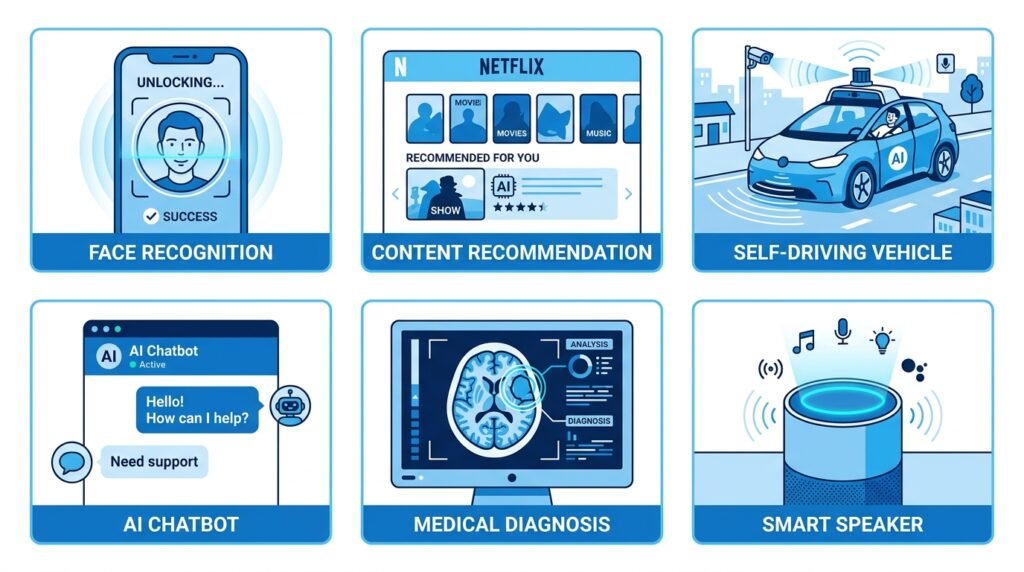
AI is not an abstract future concept. It is already running quietly in the background of your daily life.
Smartphones
Your phone uses AI constantly. Face ID recognizes your face. Thecamera adjusts settings automatically for better photos. Your keyboard predicts your next word. Voice assistants understand your questions and respond in natural language. AI-powered noise cancellation on calls filters background sound in real time.
Some premium headphones now use what is sometimes called artificial intelligence headphones technology, AI-powered audio processing that adapts sound profiles to your environment, ear shape, and listening habits in real time. This is a narrow AI applied to personal audio.
Netflix Recommendations
Netflix’s recommendation engine analyses your watch history, time of day, how long you watched before stopping, what similar users watched, and dozens of other signals, then predicts what you are most likely to enjoy next. It is estimated that over 80% of content watched on Netflix comes from AI recommendations rather than active search.
Self-Driving Cars
Autonomous vehicles use computer vision, sensor fusion, real-time decision-making, and deep learning to navigate roads. Tesla, Waymo, and other companies have deployed systems that handle highway driving, parking, and urban navigation with increasing reliability. Full autonomy in complex urban environments remains an active research challenge.
Chatbots and Virtual Assistants
Modern AI chatbots, built on large language models like those powering ChatGPT and Google Gemini, can hold natural conversations, answer complex questions, draft documents, write code, and complete tasks on your behalf. These are no longer the frustrating rule-based bots of the early 2010s. They genuinely understand context and nuance.
Healthcare Tools
AI is transforming medicine faster than almost any other sector. AI tools now detect cancers in medical imaging with accuracy matching experienced radiologists. Drug discovery timelines that once took decades are being compressed into years. AI-powered diagnostics tools assist doctors in emergency triage, rare disease identification, and personalised treatment planning.
Benefits of Artificial Intelligence
AI delivers genuine, measurable benefits across virtually every domain of human activity.
Speed and scale: AI processes information and completes tasks at a speed and scale that humans simply cannot match. A task that takes a human analyst a week can take an AI system minutes.
Consistency: AI does not get tired, distracted, or emotional. It applies the same level of attention to the thousandth task as it did to the first.
Accessibility: AI tools are democratising access to expertise. A small business owner can now access marketing, legal, design, and coding assistance that previously required expensive specialists.
Medical breakthroughs: From drug discovery to early disease detection, AI is accelerating medical progress and saving lives in ways that were impossible even five years ago.
Personalization: AI tailors experiences to individuals at scale, personalized learning, personalized healthcare, personalized content, in ways that manual approaches never could.
Economic productivity: According to McKinsey, AI could add $13 trillion to global economic output by 2030, primarily through automation of repetitive tasks and acceleration of knowledge work.
Risks of Artificial Intelligence
AI’s benefits come with real and serious risks that deserve honest discussion, not dismissal.
Job Displacement
Automation powered by AI is already displacing routine jobs in manufacturing, data entry, customer service, and logistics. The World Economic Forum estimates that AI will displace 85 million jobs globally by 2025, while creating 97 million new roles. The net is positive, but the transition will be painful forworkers in affected industries, particularly those without access to retraining.
Bias
AI systems learn from historical data , and historical data often contains human bias. When biased data trains an AI, the AI reproduces and sometimes amplifies that bias at scale. This has caused documented problems in hiring algorithms, facial recognition systems, and criminal justice risk assessments. Addressing bias in AI is one of the most important unsolved challenges in the field.
Privacy Issues
AI systems that process personal data, from browsing behaviour to medical records to location history, raise profound privacy concerns. The ability to aggregate and analyse data at AI scale makes surveillance capabilities far more powerful than anything previously available.
Deepfakes
Generative AI makes it possible to create hyper-realistic fake videos, images, and audio of real people saying and doing things they never did. Deepfake technology is already being used for fraud, political disinformation, and non-consensual intimate imagery. Detection tools exist but consistently lag behind generation capabilities.
Misinformation
Large language models can generate plausible-sounding but entirely false information with ease and at enormous scale. The combination of convincing AI-generated text, images, and video creates misinformation risks that challenge existing fact-checking systems and public trust in media.
Best AI Tools for Beginners in 2026
You do not need to understand how AI works to start using it. These tools are genuinely beginner-friendly and immediately useful.
ChatGPT (OpenAI)
The tool that brought generative AI to mainstream awareness. ChatGPT can write, summarize, explain, code, analyze, and brainstorm across virtually any topic. The free version is powerful. ChatGPT Plus ($20/month) adds GPT-4o, faster responses, image generation, and access to custom GPTs. Best starting point for most beginners.
Google Gemini
Google’s answer to ChatGPT, with the significant advantage of real-time web access built in. Gemini integrates directly with Google Workspace, Docs, Gmail, Sheets, Slides, making it particularly powerful for users already in the Google ecosystem. Artificial intelligence Gemini also powers Google’s AI Overviews in search results, making it one of the most widely encountered AI systems in the world even if users do not realize it.
Claude (Anthropic)
Claude is widely regarded as one of the best AI tools forlong-form writing, nuanced analysis, and tasks requiring careful reasoning. It handles very long documents, entire books, research reports, legal contract, in a single conversation. Claude is also noted for being more cautious and transparent about uncertainty than some competitors, which matters for professional use cases.
Midjourney
The leading AI image generation tool in 2026. Midjourney produces stunning, artistic images from text descriptions and is the preferred tool for designers, content creators, and marketing teams. It runs through Discord, which has a learning curve, but the output quality is exceptional.
Canva AI Tools
Canva has integrated a suite of AI features, text-to-image generation, Magic Write for copy, background removal, automatic design suggestions, and presentation creation, into a platform that millions of people already use. For non-designers who need professional-looking content quickly, Canva AI is the most accessible entry point available.
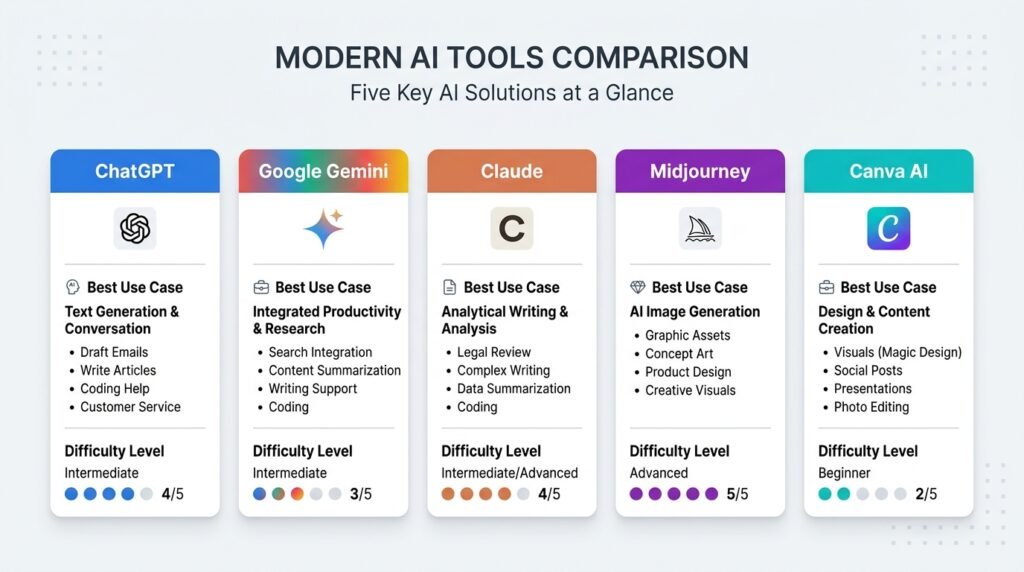
| Tool | Best For | Free Tier | Difficulty |
| ChatGPT | Writing, coding, research | Yes | Beginner |
| Google Gemini | Search-connected tasks | Yes | Beginner |
| Claude | Long documents, analysis | Yes | Beginner |
| Midjourney | Image generation | No | Intermediate |
| Canva AI | Design, content creation | Yes | Beginner |
You do not need to understand how AI works to start using it. These tools are genuinely beginner-friendly and immediately useful.
How Businesses Build AI Applications
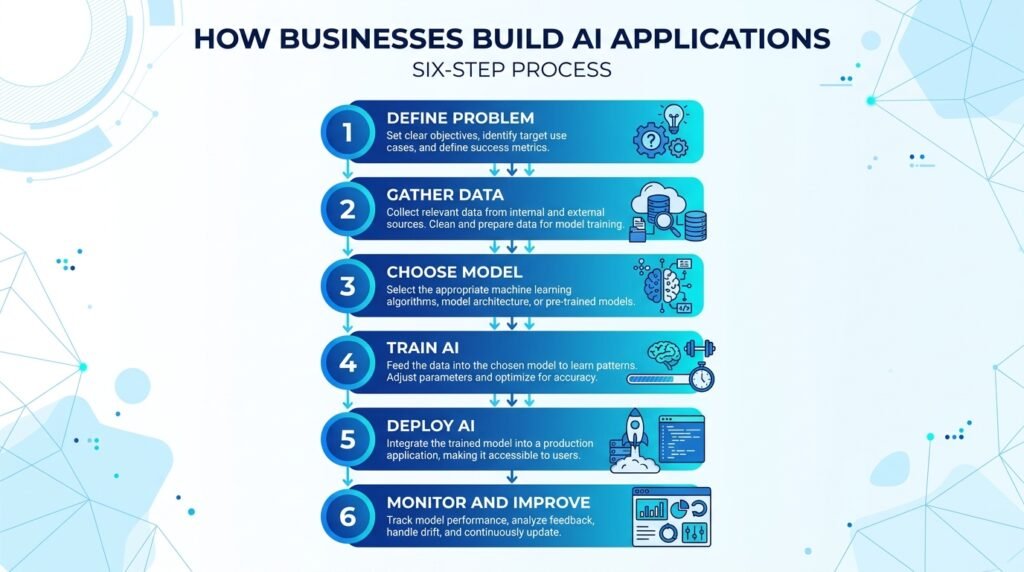
Understanding how AI applications are built helps demystify what AI actually is, and reveals how human artificial intelligence collaboration works in practice. Here is the real process, simplified.
Step 1: Define the Problem
Every successful AI application starts with a specific, clearly defined problem. Not “use AI to improve our business“, but “reduce customer churn by identifying at-risk users 30 days before they cancel.” The more specific the problem, the more useful the AI solution.
Step 2: Gather Data
AI learns from data. Before any model can be built, businesses must collect, clean, and organise the data that will train it. This is consistently the most time-consuming step, and the most important. Garbage data produces garbage AI.
Step 3: Choose a Model
Different problems require different model types. Classification problems (spam or not spam), regression problems (predicting a price), generation problems (writing text), and recognition problems (identifying images) each have model architectures best suited to them.
Step 4: Train the AI
Training is the process of feeding data through the chosen model architecture and adjusting its parameters until it performs well on the task. This requiressignificant computing power and can take hours to months depending on the complexity of the model.
Step 5: Deploy the AI
Once trained and tested, the model is deployed, integrated into a product, application, or workflow where real users interact with it. Deployment involves API connections, user interface design, and performance optimization.
Step 6: Monitor and Improve
AI systems are not set-and-forget. They require ongoing monitoring for accuracy, bias drift, and performance degradation as real-world data evolves. The best AI systems improve continuously through a feedback loop between deployment data and model updates.
How to Start Learning AI as a Beginner
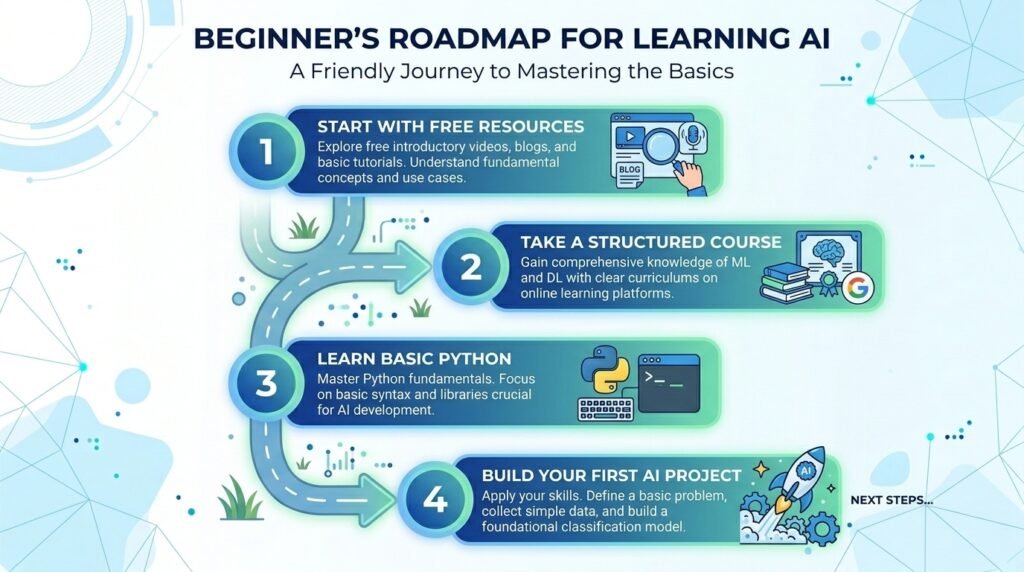
You do not need to be a programmer to start learning AI. Here is a realistic roadmap.
Free Resources to Start Today
YouTube: Channels like 3Blue1Brown (mathematics of AI), Sentdex (Python and machine learning), and Google’s own AI education channel offer world-class free content.
Google AI Essentials: A free beginner course from Google covering AI fundamentals, practical tools, and responsible AI use. No prior experience required.
Elements of AI: A free online course created by the University of Helsinki and Reaktor. One of the most widely praised beginner AI courses available. Genuinely no coding required.
Khan Academy: Free courses on computer science fundamentals that build the foundation for AI learning.
Courses Worth Paying For
DeepLearning.AI (Coursera): Andrew Ng’s courses are the gold standard for structured AI education. “AI For Everyone” is a non-technical overview that is perfect for beginners. The Machine Learning Specialisation goes deeper for those ready to progress.
Fast.ai: A practical, top-down approach to deep learning that has produced professional-grade AI practitioners. Free and remarkably effective.
MIT OpenCourseWare : MIT’s actual course materials, free online, covering everything from introduction to machine learning to advanced deep learning research.
Do You Need to Know How to Code?
Honestly, it depends on your goal.
To use AI tools: No coding required whatsoever. To build simple AI applications: Basic Python is helpful but learnable in weeks. To develop AI models from scratch: Python plus mathematics (linear algebra, statistics, calculus) is essential.
Python is the dominant language of AI development. If you want to go beyond using AI tools into building with them, Python is where to start. Resources like Codecademy, freeCodeCamp, and Python.org’s official tutorials make it accessible to complete beginners.
AI Career Paths in 2026
The AI job market is expanding faster than the talent pipeline can fill it. Key roles include:
AI/ML Engineer: Builds and deploys machine learning models. High demand, high salary. Requires strong Python and mathematics skills.
Data Scientist: Analyses data and builds predictive models. Strong overlap with AI/ML engineering.
AI Product Manager: Bridges technical AI teams and business stakeholders. Requires understanding of AI capabilities without deep technical expertise.
Prompt Engineer: Specialises in crafting effective inputs for large language models. A newer role that rewards language skills and systematic thinking.
AI Ethics Researcher: Focuses on fairness, transparency, accountability, and the societal impact of AI systems. Growing rapidly as regulation increases.
AI Content Strategist: Uses AI tools to scale content production while maintaining quality and brand voice. Highly accessible for non-technical professionals.
Future of Artificial Intelligence
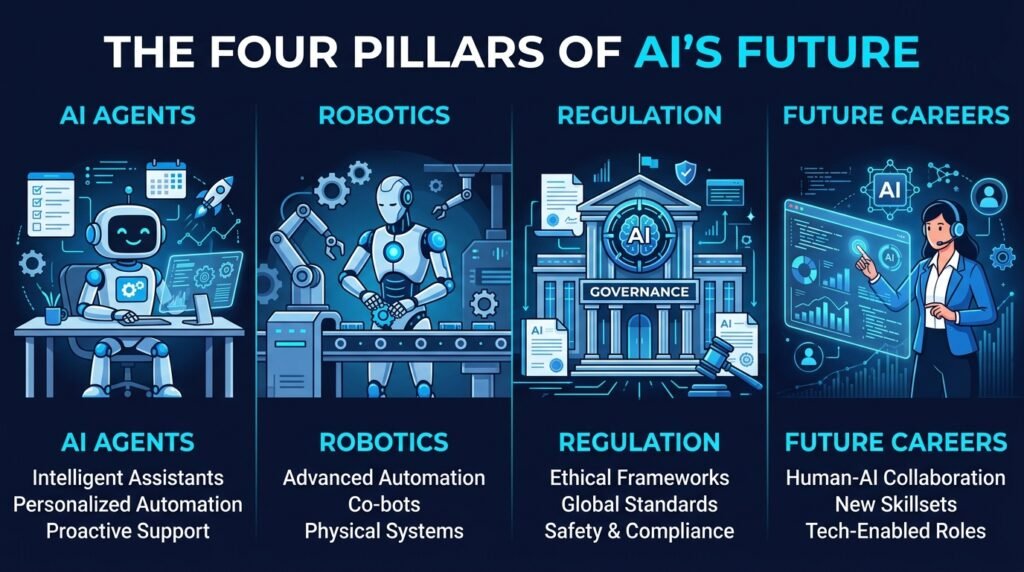
The next five years of AI development will likely be more transformative than the previous twenty. Here is what is coming.
AI Agents Becoming Mainstream
In 2026, AI agents, systems that autonomously complete multi-step tasks, are moving from experimental to mainstream. Within the next few years, AI agents will handle scheduling, research, email management, travel booking, software testing, and business operations with minimal human supervision. The shift from AI as a tool to AI as a collaborator is already underway.
Robotics and Physical AI
The combination of advanced AI with robotics is producing systems that can navigate physical environments, handle objects, and perform complex manual tasks. Companies like Boston Dynamics, Tesla (with its Optimus robot), and Figure AI are racing to deploy humanoid robots in warehouses, factories, and eventually homes.
AI Regulation
Governments worldwide are moving to regulate AI. The EU AI Act; the world’s first comprehensive AI regulation, came into force in 2024 and is being implemented through 2026 and beyond. The United States, United Kingdom, China, and others are developing their own frameworks. Regulation will shape which AI applications are permitted, how AI systems must be audited, and what rights individuals have regarding AI decisions that affect them.
Future Careers in AI
AI is not simply replacing jobs, it is creating entirely new categories of work while transforming existing roles. The professionals who thrive will be those who combine domain expertise (medicine, law, finance, education) with AI literacy. The ability to direct, evaluate, and collaborate with AI systems is becoming a core professional skill across every industry.
Frequently Asked Questions
What is artificial intelligence in simple terms?
Artificial intelligence is software that learns from data and performs tasks that normally require human thinking, like understanding language, recognising images, making decisions, and solving problems. It is not magic or science fiction. It is pattern recognition at an enormous scale, powered by data and computing power.
Is AI difficult to learn?
It depends on your goal. Using AI tools like ChatGPT or Google Gemini requires no technical knowledge at all. Understanding how AI works conceptually takes a few hours of reading. Building AI models from scratch requires Python programming and a foundation in mathematics. Most people only need the first two levels, and both are very accessible in 2026.
Can I build AI without coding?
Yes, for many applications. Platforms like Google’s Vertex AI, Microsoft Azure AI, and various no-code AI builders allow non-programmers to create AI-powered applications using visual interfaces. However, for custom model development or advanced applications, coding remains essential.
What are the best AI tools for beginners?
The best starting points in 2026 are ChatGPT (for writing and research), Google Gemini (for search-connected tasks), Claude (for long documents and analysis), and Canva AI (for design and content creation). All have free tiers and require zero technical knowledge to start using immediately.
Will AI replace jobs?
AI will automate specific tasks within jobs more than it will eliminate entire job categories outright. Roles centered on repetitive, predictable, rule-based tasks face the most disruption. Roles requiring creativity, emotional intelligence, complex judgment, and physical dexterity in unpredictable environments are more resilient. The World Economic Forum projects net job creation from AI, but significant displacement in specific sectors during the transition.
Is AI safe?
Current AI tools are generally safe to use for everyday tasks. The broader safety questions around bias, misinformation, privacy, and long-term risks from increasingly capable systems, are real and actively debated by researchers, policymakers, and AI companies themselves. Anthropic, OpenAI, and Google DeepMind all have dedicated safety research teams working on these challenges. Responsible use, critical evaluation of AI outputs, and emerging regulation all contribute to managing AI risks.
How much does AI development cost?
The range is enormous. Using existing AI tools costs nothing to a few hundred dollars per month. Building a custom AI application on top of existing APIs (like OpenAI’s) costs thousands to tens of thousands of dollars. Training a large language model from scratch costs millions to hundreds of millions of dollars in computing alone. For most businesses, building on existing AI platforms rather than training models from scratch is the practical and cost-effective path.
What industries use AI the most?
Healthcare (diagnostics, drug discovery, administrative automation), financial services (fraud detection, algorithmic trading, credit scoring), retail and e-commerce (recommendation engines, inventory management, customer service), manufacturing (predictive maintenance, quality control, robotics), and technology (software development, cybersecurity, product personalization) are the leading sectors for AI adoption in 2026.
Final Thoughts
Artificial intelligence is not something happening to you, it is something you can understand, use, and shape.
The people who will thrive in an AI-powered world are not necessarily the ones who build AI systems. They are the ones who understand what AI can and cannot do, know which tools to use for which problems, and can direct AI effectively to achieve their goals.
You have now taken the most important step: building a foundation of genuine understanding rather than vague anxiety or uncritical hype.
Your next step is simple. Pick one tool from the beginner list above ChatGPT, Google Gemini, Claude, or Canva AI and spend 20 minutes exploring it today. The fastest way to understand AI is to use it.
Have a question about AI that this guide did not answer? Drop it in the comments below and we will cover it in a future update.