
How Smart Product Recommendations Help You Shop Better and Help Stores Sell More
Have you ever opened an online store, scrolled through hundreds of products, and left without buying anything simply because you had no idea where to start?
That feeling has a name: choice overload. And it is one of the biggest reasons ecommerce stores lose sales every single day.
Guided buying is the solution. Whether you are shopping for a laptop, a pair of headphones, a diamond ring, an office chair, or a desktop PC guided buying walks you from confused to confident in minutes.
This guide explains exactly what it is, how it works, and why it matters for shoppers and store owners alike.
What Is Guided Buying?
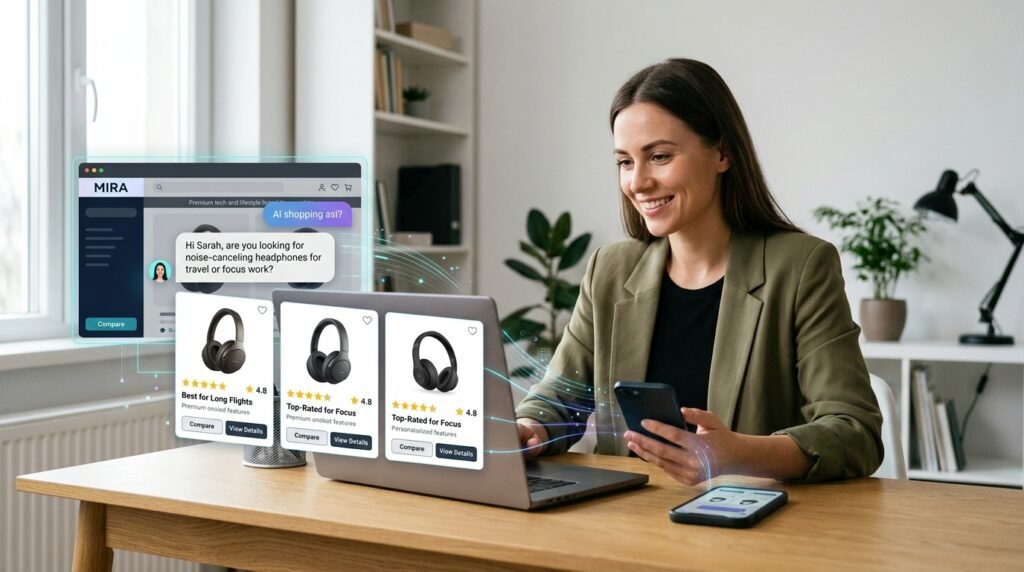
Think of it as having a knowledgeable store assistant available 24/7. Instead of leaving you to scroll through 3,000 results, it asks what you actually need and shows you the three products that fit.
In the digital world, that assistant is powered by recommendation engines, AI chat tools, and interactive quizzes. The goal is always the same: reduce friction, build confidence, and help the shopper decide.
Guided Buying vs Buyer’s Guides: What’s the Difference?
| Feature | Buyer’s Guide | Guided Buying |
| Format | Static written article | Interactive, dynamic, real-time |
| Personalization | Same for every reader | Tailored to each individual |
| Goal | Educate broadly | Convert traffic into purchases |
| Technology | Manually written content | AI, quizzes, filters, chat |
| Best example | “Best MacBook Buying Guide 2026” | Amazon‘s ‘Customers also bought’ |
Buyer’s guides bring the traffic. Guided buying closes the sale. The strongest ecommerce strategies use both together.
How Guided Buying Works
Guided buying is not a single technology it is a combination of systems working together to create a clear path from discovery to purchase.
1. Recommendation Engines
These analyze what you browse, search, and buy then predict what you are most likely to want next. There are three types:
| Engine Type | How It Works | Example |
| Collaborative Filtering | Recommends what similar shoppers bought | Amazon: ‘Customers also bought’ |
| Content-Based Filtering | Matches products with similar attributes to what you viewed | ‘Because you viewed noise-cancelling headphones…’ |
| Hybrid AI Model | Combines both approaches with real-time signals | Amazon, Netflix, TikTok all use hybrid models |
2. Product Quizzes
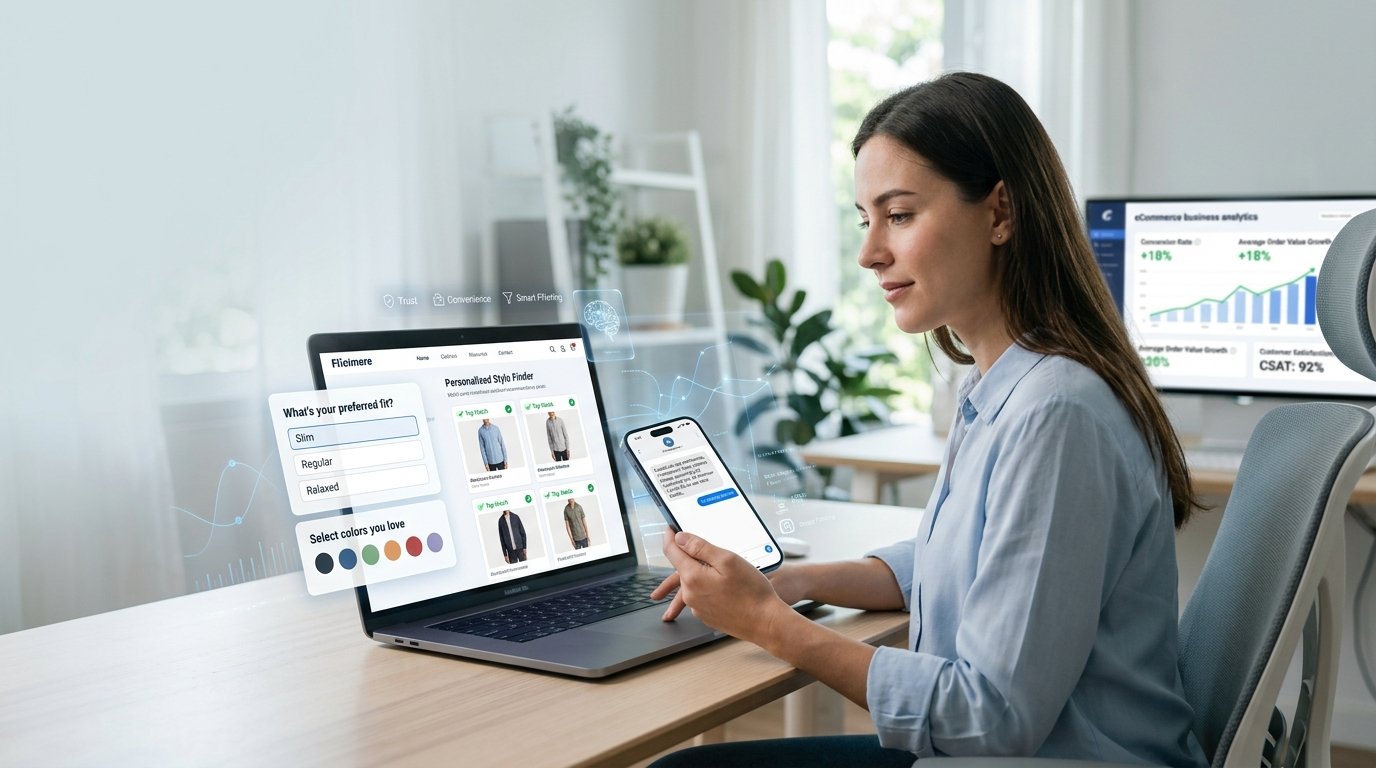
Quizzes ask shoppers 5–7 targeted questions about their needs, budget, and use case then return a curated shortlist of 3–5 matching products with a plain-language explanation of why each fits. They are among the highest-converting guided buying tools available. Brands using Octane AI quizzes report 3–5x higher conversion rates on quiz-recommended products versus standard category pages.
3. AI Shopping Assistants
AI chat tools let shoppers describe what they need in plain language and get instant, relevant recommendations. Instead of clicking through filters, a shopper types: “I need a lightweight laptop under $900 for college with long battery life” and gets a curated answer in seconds. Amazon’s Rufus, Google’s Gemini Shopping, and Shopify‘s native AI tools all operate this way in 2026.
4. Smart Filters
Need-based filters outperform standard attribute filters consistently. Compare:
| Standard Filters | Smart Guided Filters |
| Price: Low to High | Under $200 / $200–$400 / $400+ |
| Type: Over-Ear / In-Ear | Best for Commuting / Gym / Gaming / Work Calls |
| Battery: 10h / 20h / 30h+ | Long Battery Life (20h+) |
| Brand: Sony / Bose / Apple | Most Reviewed / Best Value / Editor’s Pick |
Usability research from the Nielsen Norman Group shows need-based filters reduce time to product decision by 40–60% compared to attribute-based filters. The implementation difference is primarily in labeling the underlying technology is often identical.
4 Key Benefits of Guided Buying
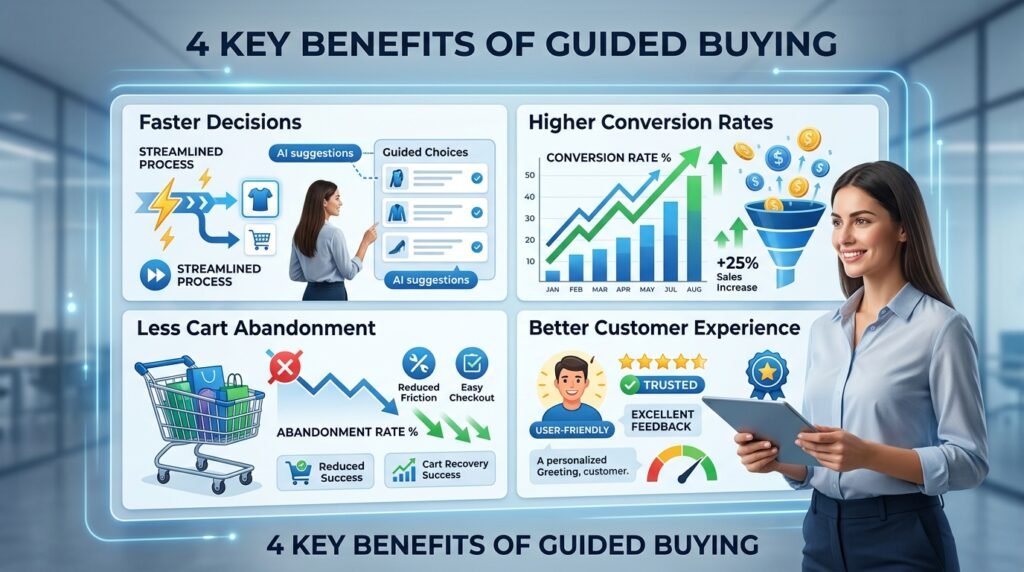
• Faster decisions: Shoppers who encounter effective guided navigation make purchase decisions in 60–70% less time, according to Nielsen Norman Group research on ecommerce decision-making.
• Higher conversion rates: McKinsey research on personalization in retail found that companies excelling at personalization generate 40% more revenue from those activities compared to average players.
• Less cart abandonment: The Baymard Institute reports an industry-wide cart abandonment rate of ~70%. Guided buying reduces abandonment by building purchase conviction before the cart so shoppers arrive confident, not hesitant.
• Better customer experience: Shoppers who feel genuinely guided trust the brand more, return more often, and refer others. Shopify merchants using guided selling tools consistently report higher Net Promoter Scores and lower return rates.
Real-World Guided Buying Examples
Amazon
Amazon runs guided buying at every touchpoint: a personalized homepage, intent-ranked search results, ‘Customers who bought this also bought’ on product pages, and ‘Add to your order’ suggestions at checkout. Its recommendation engine is widely cited as a foundational driver of the company’s growth; the logic has been studied and replicated by retailers worldwide.
Netflix
Netflix is the most instructive non-retail example: every homepage row (‘Because you watched,’ ‘Top picks for you’) is a guided discovery experience powered by the same recommendation logic used in ecommerce. Netflix has discussed publicly how personalization reduces subscriber churn. The principle translates directly if recommendations can retain subscribers at Netflix’s scale, they can meaningfully improve conversion rates for an independent Shopify store.
TikTok Shop
TikTok Shop embeds guided buying inside entertainment content. When a creator demonstrates headphones or a kitchen gadget, the recommendation is the content itself and the purchase happens within the app at the moment of highest interest. TikTok’s For You Page is effectively the world’s largest personalized guided buying engine, and most users do not recognize it as such because it feels like entertainment.
Diamond Retailers
Buying a diamond is one of the highest-anxiety purchases most people make. Leading online diamond retailers like Brilliant Earth and James Allen use guided quizzes (asking about budget, cut priority, ring style, and certification preference), 360-degree diamond viewers (so shoppers can inspect the actual stone before purchasing online), and plain-language cut quality filters (defaulting to Excellent/Ideal cut with an explanation of why it matters) to walk nervous buyers from confusion to confident purchase. This category shows guided buying at its most valuable: maximum ticket price, maximum buyer anxiety, minimum buyer expertise.
Common Buying Guide Categories and Guided Tools That Work
| Category | Primary Buyer Question | Best Guided Tool |
| Headphones buying guide | Over-ear vs in-ear? ANC? Budget? | Product quiz: use case + budget + fit preference |
| MacBook / Apple buying guide | Which model for my work type? | Quiz: job type + software needs + portability |
| Laptop / notebook buying guide | Best specs for my use case? | Smart filter: use case + budget + weight |
| Desktop PC buying guide | Build or buy? Which specs matter? | Comparison tool: gaming vs work vs creative |
| Electric bicycle buying guide | Motor, range, terrain where to start? | AI chat: commute distance + terrain + budget |
| Office chair buying guide | What supports 8 hours of sitting? | Quiz: height + back issue + budget |
| Diamond buying guide | 4Cs tradeoffs on my budget? | Guided filter + 360° viewer + cert explainer |
| Wrist watch buying guide | Dress vs casual? Automatic vs quartz? | Quiz: lifestyle + budget + style |
| Printer buying guide | Inkjet vs laser? Home vs office? | Smart filter: volume + color needs + budget |
| Bed frame / furniture guides | Size, material, assembly ease? | Comparison tool + room size filter |
How to Build a Guided Buying Strategy (5 Steps)
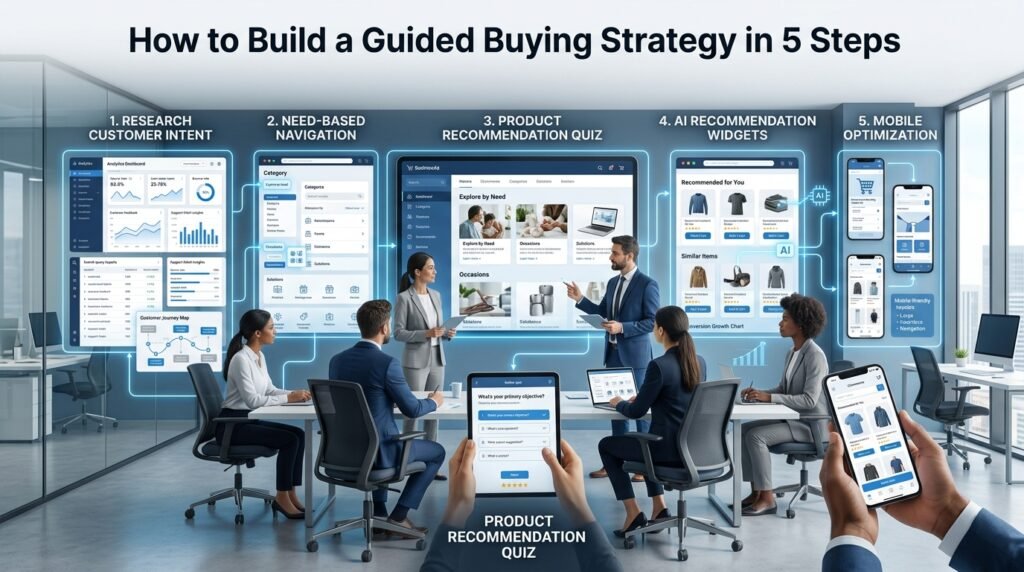
Step 1: Research Customer Intent
Export your site search queries for the past 90 days. The exact language shoppers type is the clearest signal of what guidance they need. Group support tickets by theme every repeated question is a guided buying gap. Read competitor reviews to find what guidance buyers wished they had received before purchasing.
Step 2: Restructure Navigation by Need, Not Attribute
Instead of “Over-Ear / On-Ear / In-Ear,” try “For Commuting / Gaming / Work Calls / Gym.” Need-based navigation helps shoppers self-select immediately and creates landing pages that match high-intent long-tail search queries improving both conversion and SEO simultaneously.
Step 3: Add a Product Recommendation Quiz
Build a 5–7 question quiz for your highest-traffic category. Map quiz outcomes to your top 10 products. Use Octane AI (Shopify-native), Typeform + Zapier, or Interact Quiz Builder. The results page must explain why the recommendation fits the shopper’s specific answers without that explanation, it is just another product listing.
Step 4: Install AI Recommendation Widgets
Add ‘Customers also bought’ and ‘You might also like’ widgets to product pages using Rebuy or LimeSpot (Shopify). These typically require no custom development and can be live within a day. A/B test them against your current product page to measure lift before expanding sitewide.
Step 5: Optimize Everything for Mobile
Over 70% of ecommerce traffic arrives on mobile. Quiz interfaces need single-question-per-screen layouts with large tap targets. Comparison tools need vertical card layouts, not horizontal tables that break on small screens. Test on actual mobile devices on 4G not desktop simulators.
4 Guided Buying Mistakes to Avoid
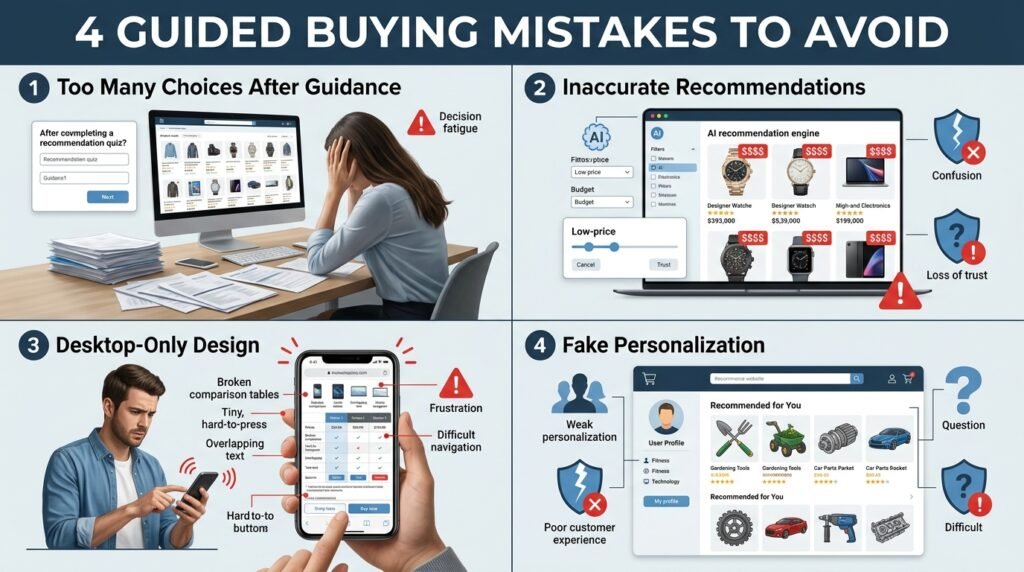
• Too many choices after guidance: A quiz that returns 150 results has not solved choice overload; it added an extra step before it. Narrow to 3–7 relevant products maximum.
• Inaccurate recommendations: A shopper who says $300 budget and sees $800 recommendations immediately loses trust. Regularly audit whether recommendations match stated criteria.
• Desktop-only design: Filter panels that need horizontal scrolling, quizzes with tiny tap targets, and comparison tables that break on mobile are failing the majority of your visitors.
• Generic ‘personalization’: ‘Recommended for you’ powered by nothing meaningful is worse than no personalization; it breaks the promise. If you cannot personalize genuinely, label it honestly (e.g. ‘Top picks in this category’).
Best Guided Buying Tools (2026)
| Tool | Best For | Key Capability |
| Rebuy Engine | Mid-to-large Shopify stores | Full guided selling: recommendations, smart cart, A/B testing |
| LimeSpot | Growing Shopify brands | AI recommendations across all page types — quick setup |
| Octane AI | DTC brands, zero-party data focus | No-code quiz builder with direct Shopify product matching |
| SearchPie / Searchie | Large catalog Shopify stores | Intent-aware smart search upgrade |
| Nosto | Mid-market ecommerce (any platform) | AI personalization for fashion, beauty, lifestyle |
| Algolia | Developer-forward stores | Highly configurable search and recommendation API |
| Dynamic Yield | Enterprise retailers ($50M+ ARR) | Full hyper-personalization across web, mobile, email, app |
Frequently Asked Questions
Q: What is guided buying?
A: Guided buying is a structured, interactive shopping experience using AI recommendations, product quizzes, smart filters, and chatbots that helps customers find the right product for their specific needs faster and with more confidence.
Q: How do I choose the right headphones?
A: Start with your primary use case: commuting (prioritize noise cancellation), gym (prioritize secure fit and sweat resistance), gaming (prioritizes spatial audio and microphone quality). Set a budget meaningful quality improvements occur up to around $300, with diminishing returns above that for most buyers. Use a product quiz on any major headphone retailer to narrow the field in under 5 minutes.
Q: How do I choose the right MacBook or laptop?
Identify your primary use before looking at specs: student productivity (MacBook Air prioritize battery and weight), creative work (MacBook Pro or a Windows laptop with color-accurate display and dedicated GPU), software development (prioritize 16GB+ RAM). For most non-developers, the MacBook Air handles all standard tasks at $400 less than the Pro.
Q: How do I buy a diamond?
A: Prioritize cut quality above all else a well-cut 1.0 carat diamond looks dramatically better than a poorly-cut 1.2 carat. Choose G or H color (near-colorless, significantly cheaper than D–F with no visible difference). For clarity, VS2 or SI1 are eye-clean at most carat weights. Use GIA-certified diamonds for the most reliable grading. Use guided filter tools on retailers like James Allen or Blue Nile to see exactly what your budget buys with different tradeoff priorities.
Q: How do recommendation engines work?
A: They use three main approaches: collaborative filtering (what similar shoppers bought), content-based filtering (products sharing attributes with what you browsed), and hybrid AI models that combine both with real-time context signals delivering increasingly accurate recommendations as more data is collected.
Q: What tools help create guided buying experiences?
A: For Shopify: Rebuy (full suite), LimeSpot (recommendations), Octane AI (quizzes), SearchPie (smart search). For mid-market: Nosto, Bloomreach. For enterprise: Dynamic Yield, Salesforce Commerce Cloud. For quizzes on any platform: Typeform + Zapier or Interact Quiz Builder.
Conclusion
Guided buying is not a feature, it is a philosophy about how shopping should work. The best shopping experiences have always been guided: the specialist who asks what you photograph before recommending a lens, the jeweler who asks about your partner before showing rings.
Digital commerce is finally catching up to that standard. And the gap between guided and unguided stores is widening. Merchants who invest now starting with a single product quiz or need-based navigation restructure build a conversion advantage that compounds with every improvement.
Start with one thing this week. Measure it. Build from there.
Three Things to Do This Week
1. Export your site search queries and identify your top 5 unanswered shopper questions.
2. Restructure one category page around use cases instead of product attributes.
3. Build one product quiz for your highest-traffic category using Octane AI or Typeform.