
If you’ve ever stared at a cell phone plan page feeling completely lost ; you’re not alone.
Between confusing terms like “MVNO,” “eSIM,” and “deprioritization,” choosing a cell phone plan feels more complicated than it needs to be. And most guides out there assume you already know what all of that means.
This guide doesn’t.
Whether you’re getting your first phone, switching carriers, or just trying to understand why your bill is higher than advertised, this is your plain-English starting point. By the end, you’ll know exactly what to look for, which companies are worth your money, and how to get set up without any surprises.
Let’s start from the very beginning.
Table of Contents
- What Is a Cell Phone Plan?
- The Main Cell Phone Companies in the US
- Prepaid vs Postpaid Plans , Which Is Better for Beginners?
- How Much Data Do You Actually Need?
- Affordable Cell Phone Plans Worth Considering in 2026
- Cell Phone Parts You Should Know About
- What Are Starlink Cell Phones?
- What About the Tesla Cell Phone?
- Hidden Fees , What Your Bill Actually Costs
- 4G vs 5G , Does It Actually Matter?
- How to Switch Carriers Without Losing Your Number
- Free and Low-Cost Plans (Lifeline Program)
- How to Stop Spam and Unwanted Calls
- Frequently Asked Questions
What Is a Cell Phone Plan?
A cell phone plan is a service agreement between you and a wireless carrier that lets your phone make calls, send texts, and connect to the internet.
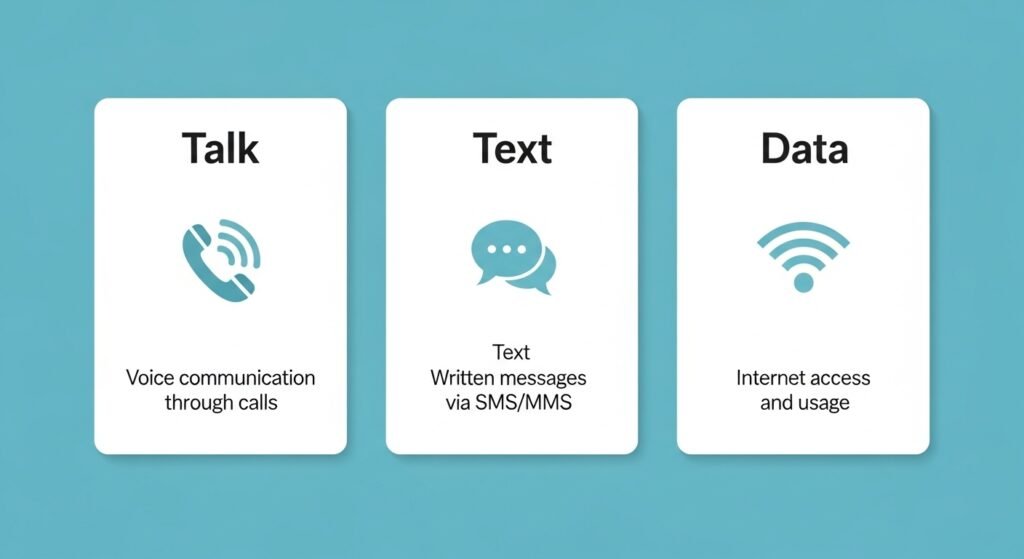
Every plan includes some combination of three things:
- Talk : minutes for phone calls
- Text : SMS and MMS messaging
- Data : mobile internet for apps, streaming, and browsing
When you sign up for a plan, you pay a monthly fee in exchange for a set amount of these services. Some plans offer unlimited everything. Others let you pay for only what you need.
How SIM Cards and eSIMs Work
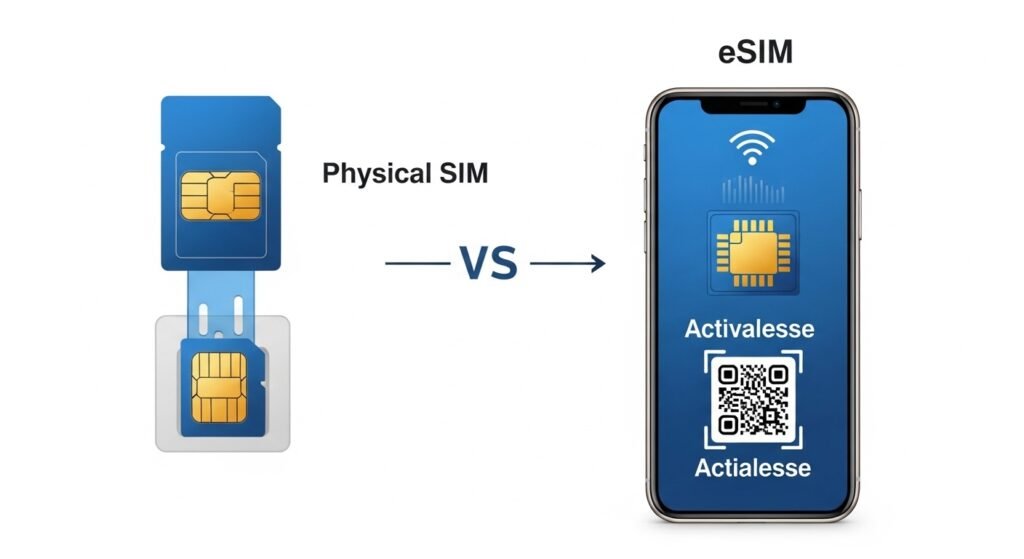
Your phone connects to a carrier’s network through a SIM card , a tiny chip that identifies your phone and the plan you’re on.
There are two types:
- Physical SIM card : A small removable chip you insert into your phone. If you switch carriers, you get a new SIM card.
- eSIM : A digital SIM built directly into your phone. No physical card needed. You activate it by scanning a QR code or tapping through the settings. Most modern iPhones and Android devices support eSIM.
Both do the same job. eSIM is just more convenient, especially if you switch carriers often.
Beginner Glossary
These are the most common terms you’ll run into , explained in plain English:
| Term | What It Means |
| MVNO | A smaller carrier that runs on a big network (like AT&T or Verizon) at a lower price |
| Postpaid | You’re billed at the end of the month , requires a credit check |
| Prepaid | You pay upfront , no credit check, no contract |
| Hotspot | Using your phone’s data to give Wi-Fi to another device (laptop, tablet) |
| Roaming | Using data outside your carrier’s coverage area, often costs extra |
| IMEI | Your phone’s unique ID number , needed when switching carriers |
| Deprioritization | When your carrier slows your data during busy network times |
The Main Cell Phone Companies in the US
Before you can pick a plan, you need to understand who’s actually providing cell service in the US.
The Big Three Networks
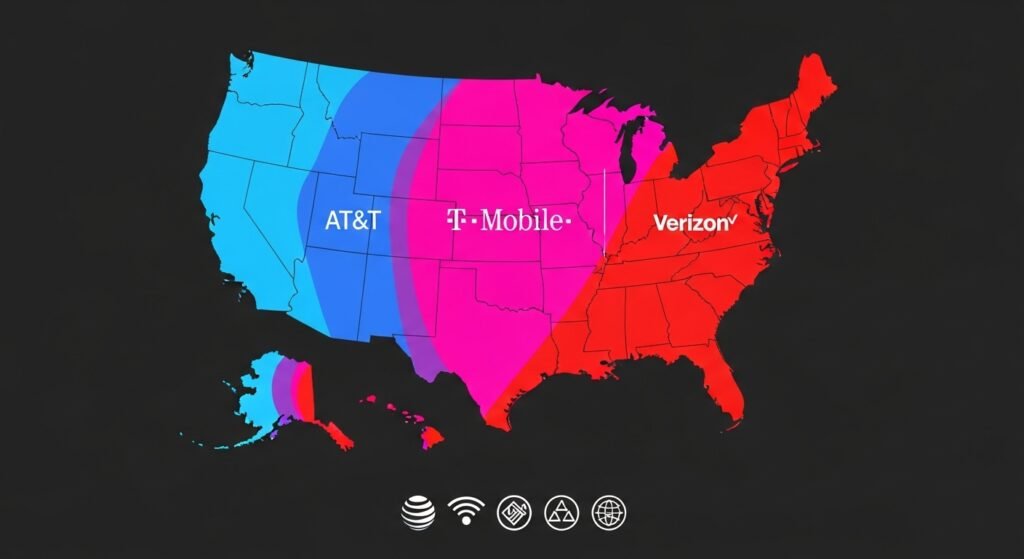
Three companies own and operate the actual cell towers that power almost all cell service in the United States:
AT&T One of the oldest and largest carriers in the country. AT&T covers over 99% of the US population on 4G LTE and has a solid 5G footprint. It tends to perform well in suburban and rural areas.
T-Mobile T-Mobile runs the largest 5G network in the US and leads competitors in average 5G download speeds. It’s especially strong in cities and has partnered with Starlink to extend coverage into remote areas where no cell signal has existed before.
Verizon Known for network reliability, Verizon is often rated highest for consistent performance; especially in rural and hard-to-reach locations. It’s typically the most expensive of the three, but its coverage is hard to beat.
According to a 2026 Statista report, these three carriers together control roughly 93% of the US wireless market.
What Are MVNOs , and Why Do They Matter?
Here’s the part most people don’t know: you don’t have to pay AT&T, T-Mobile, or Verizon directly to use their networks.
MVNOs (Mobile Virtual Network Operators) are smaller carriers that rent access to the Big Three’s towers and resell that service, often at a significantly lower price.
Popular MVNOs include:
- Mint Mobile ; runs on T-Mobile’s network
- Visible ; owned by Verizon
- Cricket Wireless ; owned by AT&T
- Consumer Cellular ; uses AT&T and T-Mobile
- Google Fi ; switches between T-Mobile and US Cellular
- US Mobile ; lets you choose your network (Verizon, T-Mobile, or AT&T)
- Tello ; T-Mobile network, plans starting at $10/month
- TextNow ; offers plans starting at $0/month
The tradeoff? During busy network times, MVNO customers may experience slower speeds than direct carrier customers , this is called deprioritization. For most users, the savings outweigh this occasional slowdown.
What Cell Phone Company Has the Largest Number of Users?
T-Mobile currently leads the US in total wireless subscribers as of 2026, having surpassed Verizon following its merger with Sprint. AT&T follows closely. Among MVNOs, Cricket Wireless and Mint Mobile rank among the most popular budget options.
Prepaid vs Postpaid Plans ; Which Is Better for Beginners?
This is one of the most important decisions you’ll make , and it’s simpler than it sounds.
Postpaid Plans
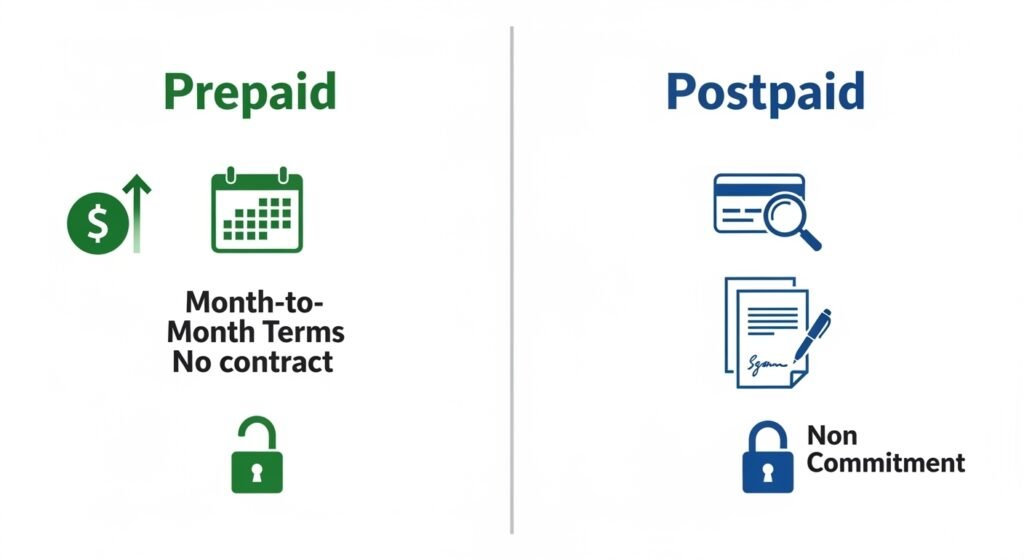
With a postpaid plan, you receive service first and pay your bill at the end of the month , similar to a utility bill.
Postpaid plans typically:
- Require a credit check
- Come with a contract (often 12–24 months)
- Offer the latest flagship phone deals and trade-ins
- Include premium features like international roaming and hotspot data
The main downside? Your bill can be unpredictable. Use too much data, add a line, or miss a payment , and costs climb fast.
Prepaid Plans
With a prepaid plan, you pay upfront for service ; no credit check, no contract, no surprises.
Prepaid plans typically:
- Cost 30–60% less than postpaid equivalents
- Require no credit history (great for students, newcomers, or those rebuilding credit)
- Work month-to-month so you can cancel or switch anytime
- Run on the same networks as postpaid plans (through MVNOs)
For beginners, prepaid plans are almost always the better starting point. You’re not locked in, you pay less, and you can always upgrade later.
How Much Data Do You Actually Need?
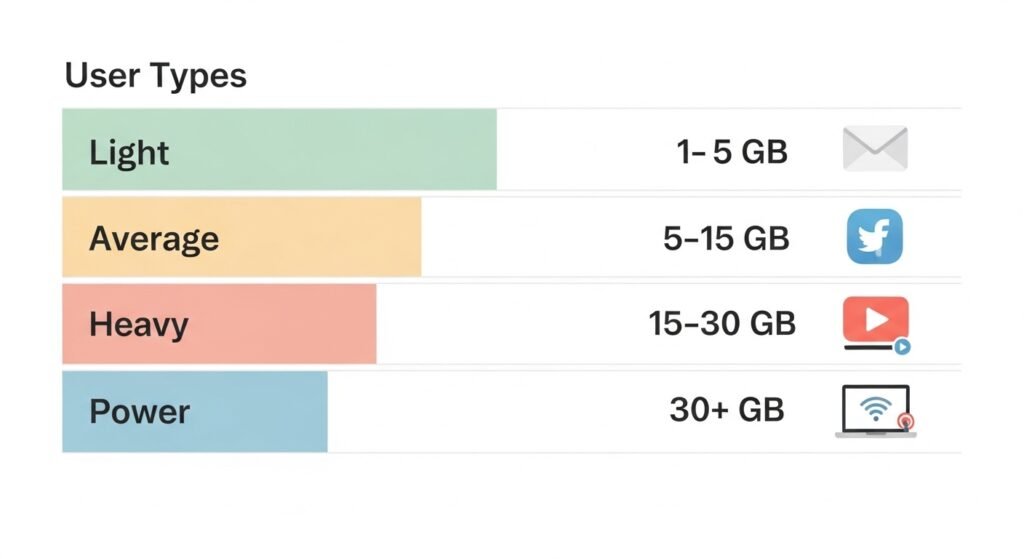
This is where most people overpay ; by buying more data than they ever use.
| User Type | Monthly Data | What You Do |
| Light user | 1–5 GB | Calls, texts, emails, occasional maps |
| Average user | 5–15 GB | Social media, music streaming, occasional YouTube |
| Heavy user | 15–30 GB | Daily video streaming, gaming, heavy social media |
| Power user | 30 GB+ | Remote work on phone, 4K streaming, heavy hotspot use |
According to J.D. Power’s 2026 wireless study, the average single-line user spends about $141 per month on their phone bill. But light users can often find plans that meet their needs for under $25 per month.
The Truth About “Unlimited” Plans
“Unlimited” doesn’t always mean unlimited. Most unlimited plans include a data threshold ; typically 20–100 GB of high-speed data. Once you pass that limit, your speeds are throttled until your next billing cycle.
Always check the fine print. The FCC’s mandatory Broadband Fact Sheet, available for every plan, shows the actual speeds you can expect.
Affordable Cell Phone Plans Worth Considering in 2026
Here are some of the best affordable cell phone plans available right now ; chosen for beginner friendliness, price, and network reliability.
Best Free Option : TextNow ($0/month)
TextNow’s Free Flex Plan gives you unlimited talk and text plus 1 GB of data for essential apps (Gmail, Maps, Uber, Lyft) at no monthly cost. You’ll need to purchase a one-time SIM card. Great for light users or as a backup line.
Best Budget Pick : Tello ($10/month)
Tello runs on T-Mobile’s network and offers a $10/month plan with unlimited talk and text plus 2 GB of data. No contract, no credit check, and you can build a custom plan to fit exactly what you need.
Best Value Overall : Mint Mobile (~$15–$30/month)
Mint Mobile consistently offers some of the best dollar-per-gigabyte pricing available. Plans start around $15/month (billed annually) and run on T-Mobile’s 5G network. One of the most popular MVNOs in the US.
Best for Families : Total Wireless (~$30/line)
Total Wireless offers a 4-line family plan for around $120/month total , that’s $30 per line. It runs on Verizon’s network, meaning strong nationwide coverage.
Best for Seniors : Consumer Cellular ($20–$50/month)
Consumer Cellular is consistently rated among the top carriers for customer service. It uses AT&T and T-Mobile networks and offers plans tailored to lighter data users. AARP members receive an additional discount.
Cell Phone Parts You Should Know About
Understanding the basic components of your phone helps you make smarter buying decisions, especially when comparing specs online.
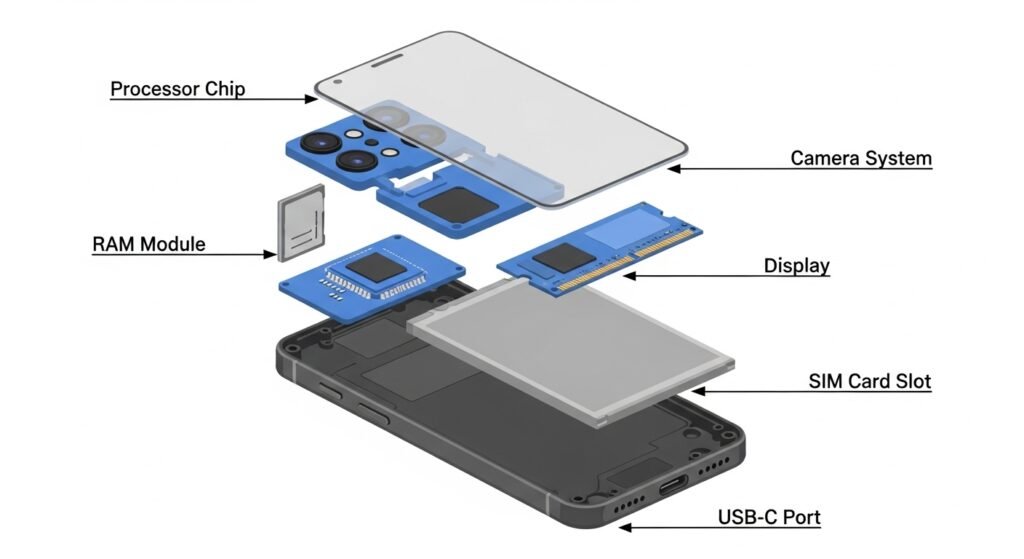
The Essential Parts
Processor (Chipset) The brain of your phone. Determines how fast apps open, how well the camera performs, and how efficiently the battery drains. Look for the Apple A18 (iPhones), Qualcomm Snapdragon 8 Gen 4 (Android flagship), or Google Tensor G4 (Pixel phones) in top-tier devices.
Battery Measured in milliamp hours (mAh). Higher mAh = longer battery life. Most mid-range phones today ship with 4,000–5,000 mAh batteries.
RAM (Random Access Memory) RAM determines how many apps stay open without slowing down. Budget phones typically have 4–6 GB of RAM; flagships carry 8–16 GB.
Storage How much your phone can hold , photos, apps, videos. Common sizes: 64 GB (basic), 128 GB (standard), 256 GB (comfortable). Look for expandable microSD storage if you need extra room later.
Display Screen quality is defined by resolution (1080p is standard, 4K for top models) and refresh rate (60 Hz standard, 120 Hz for smoother scrolling). OLED displays offer richer colors than LCD.
Camera System Modern phones often have multiple lenses , wide, ultra-wide, and telephoto. Camera quality is one of the biggest differences between budget phones and flagship models.
SIM Slot and eSIM Where your carrier connection lives. Many phones now support both physical SIM and eSIM , called Dual SIM , letting you run two numbers on one device.
Charging Port The universal standard is now USB-C. Apple moved to USB-C with the iPhone 15 and all models since.
What Are Starlink Cell Phones?
Starlink is not a phone brand ; but it is reshaping what’s possible with regular cell phones.
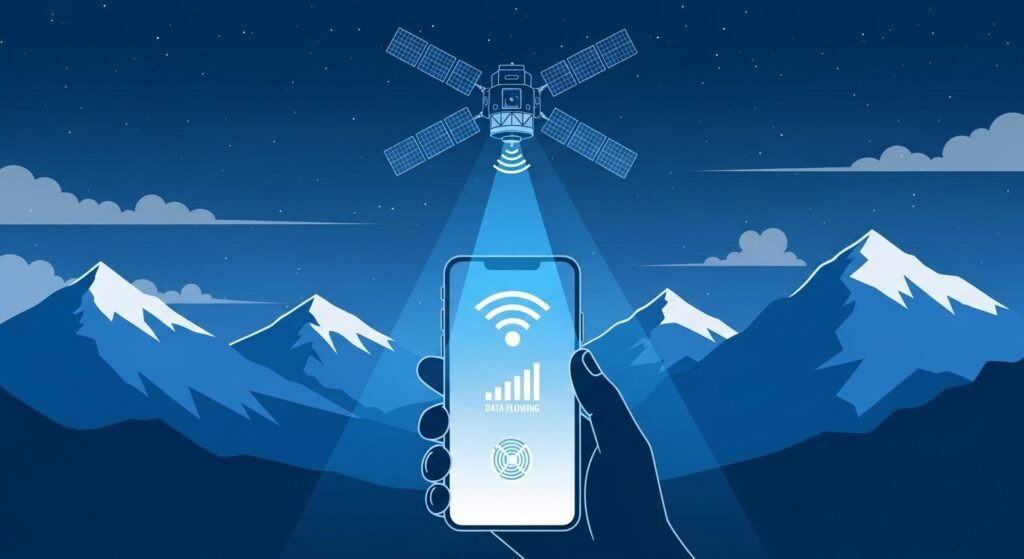
Starlink is SpaceX’s satellite internet service. In a landmark partnership, T-Mobile and SpaceX have integrated Starlink’s satellite network directly with T-Mobile smartphones, no special hardware, no new devices required.
Here’s what that means in practice:
- Standard T-Mobile phones can connect to Starlink satellites when no cell tower is in range
- This brings connectivity to remote areas, hiking trails, rural regions, and offshore locations that previously had zero cell signal
- The service currently supports text messaging and select apps, with full voice and data capabilities rolling out through 2026
As of 2026, T-Mobile’s Experience Beyond plan includes T-Satellite (Starlink-powered) connectivity. If you live or travel in areas with unreliable signal, this is a genuine reason to consider T-Mobile over other carriers.
What About the Tesla Cell Phone?
If you’ve searched for the “Tesla cell phone” recently, you’ve seen plenty of excitement and plenty of misinformation.
The honest answer: Tesla has not officially announced a consumer cell phone.
What exists online is a wave of concept renders, fan-made mockups, and YouTube speculation videos labeled “Tesla Model Pi” or “Tesla Phone.” These are not real products. No official announcement, no press release, no regulatory filing exists.
What Tesla does offer is deep smartphone integration through its app ; Tesla owners can use their iPhone or Android phone as a car key, control charging, view live camera feeds, and adjust climate settings remotely.
If Tesla ever enters the phone market, it would likely integrate with Tesla vehicles, the Starlink satellite network (given SpaceX’s relationship with Tesla’s leadership), and Tesla’s energy ecosystem. But as of April 2026, the Tesla phone remains speculation , don’t buy into the hype just yet.
Hidden Fees : What Your Bill Actually Costs
This is one of the most common shocks for new cell phone customers. A plan advertised at $30/month can easily cost $40–50 once everything is added up.
Common Hidden Fees
- Government taxes : Federal USF contributions, state and local taxes typically add $3–$10/month
- Regulatory fees : 911 service fees, number portability charges , usually $1–$3/month
- Device installments : If you’re financing a phone through your carrier, this appears as a separate line item
- Autopay discount requirements : Many plans advertise a price that only applies when enrolled in autopay via bank account or debit card. Pay by credit card and the price increases.
- Activation fees : Some carriers charge $15–$35 to set up a new line
- Hotspot caps :Unlimited plans often throttle hotspot data after a set threshold (5–50 GB)
Pro tip: Always look at the FCC Broadband Fact Sheet before committing to any plan. It’s a standardized disclosure document , required by law , that shows the real monthly cost including all fees.
4G vs 5G ; Does It Actually Matter for Beginners?
Short answer: probably not yet , but it’s worth understanding.
4G LTE is the current standard powering most everyday phone use: streaming video, browsing, video calls, music. It’s fast, reliable, and works on virtually every phone made in the last seven years.
5G is the next generation of wireless. It offers faster speeds (up to 10x faster than 4G in ideal conditions), lower latency, and capacity to connect far more devices at once.
For beginners, here’s the honest reality:
- 5G availability varies by location. In major cities it’s widespread. In rural areas, coverage is still limited.
- For everyday tasks : scrolling social media, streaming Netflix, video calling , 4G LTE is perfectly fine.
- Most new mid-range and flagship phones in 2026 include 5G capability automatically. You don’t need to prioritize it, but you won’t regret having it.
T-Mobile leads the US in 5G coverage and speed as of 2026, followed by Verizon and AT&T.
How to Switch Carriers Without Losing Your Number
Switching carriers is easier than most people expect. But there’s one rule that beginners get wrong constantly: do not cancel your old service first.
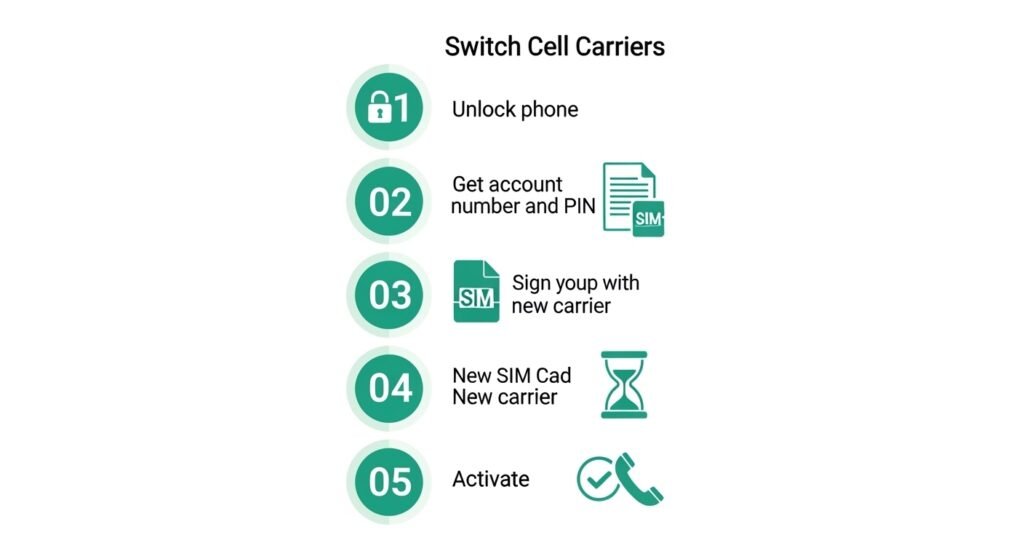
Here’s the exact process:
Step 1 : Check if your phone is unlocked
Your phone must be unlocked to work on a new carrier. If you’ve paid off your device in full, your carrier is legally required to unlock it on request. This typically takes 24–48 hours.
To find your IMEI number: go to Settings > General > About on iPhone, or dial *#06# on any Android phone. Then use your new carrier’s device compatibility checker.
Step 2 : Collect your account information
Log in to your current carrier’s account. You’ll need your account number and account PIN (different from your phone’s lock screen PIN) to authorize the number transfer.
Step 3 : Sign up with the new carrier
Choose your new plan. Purchase a SIM card or set up eSIM activation. When prompted, provide your old account number and PIN to initiate the port.
Step 4 : Wait for the number port to complete
Porting typically takes a few minutes to a few hours. During this window, your old service will briefly stop working.
Step 5 : Activate and confirm
Follow your new carrier’s activation steps. Your existing number will be live on the new network. Your old account closes automatically once the port completes — no separate cancellation call needed.
Free and Low-Cost Plans (Lifeline Program)
If budget is a serious concern, there is federal assistance specifically for phone service.
The Lifeline Program is a government benefit offering up to $9.25/month off your phone or internet bill for qualifying low-income households. For some carriers and plans, this covers the full monthly cost.
Do You Qualify?
You may be eligible if:
- Your household income is at or below 135% of the Federal Poverty Guidelines
- You participate in federal programs such as SNAP, Medicaid, SSI, or Veterans Pension
- You are a survivor of domestic violence or human trafficking (documentation required)
How to Apply
Visit lifelinesupport.org to check eligibility and find participating carriers in your area. Carriers including TruConnect, Q Link Wireless, SafeLink Wireless, and Assurance Wireless offer Lifeline-supported plans , some bringing the monthly cost to $0.
How to Stop Spam and Unwanted Calls on Your Cell Phone
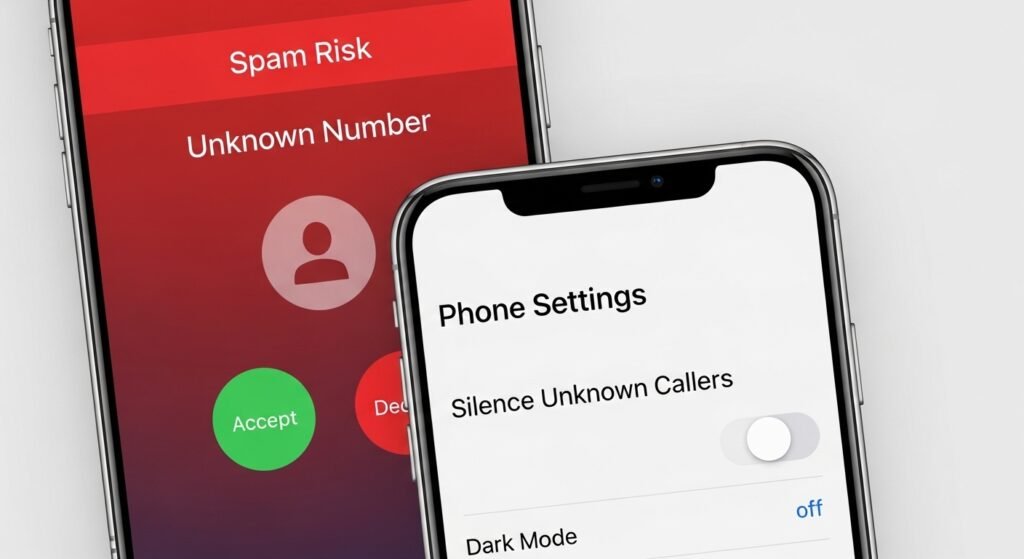
Spam calls are one of the most universal frustrations with cell phones. Here’s how to significantly reduce them.
Built-In Phone Features
On iPhone:
- Go to Settings > Phone > Silence Unknown Callers. All calls from numbers not saved in your contacts will be silenced and sent to voicemail automatically.
- To block a specific number: open the call in Recents, tap the “i” icon, scroll down, and tap “Block this Caller.”
On Android:
- Open the Phone app > tap the three-dot menu > Settings > Blocked Numbers.
- Enable Google’s spam filter: Phone app > Settings > Caller ID and Spam > Filter spam calls.
Use Your Carrier’s Free Spam Blocking
Most major carriers offer free call filtering tools:
- AT&T : ActiveArmor (free app with spam blocking and caller ID)
- T-Mobile : Scam Shield (free, automatic scam identification and blocking)
- Verizon : Call Filter (basic version is free, advanced features require a subscription)
Register with the Do Not Call Registry
Visit donotcall.gov and register your number with the FTC’s National Do Not Call Registry. Legitimate telemarketers are legally required to stop calling within 31 days of registration. It won’t stop every robocall, but it reduces calls from real businesses.
Third-Party Apps
Apps like Hiya, RoboKiller, and Truecaller offer more aggressive filtering with real-time caller ID, spam call databases, and automatic blocking. Basic versions are free; premium tiers add additional features.
Combining all four methods : phone settings, carrier tools, Do Not Call Registry, and a spam app , gives you the best protection against unwanted calls.
Frequently Asked Questions
Where can I buy cheap cell phones?
The best places to find affordable cell phones:
- Back Market : Certified refurbished iPhones and Androids at 30–50% off retail
- Amazon Renewed : Refurbished devices backed by Amazon’s warranty
- Swappa : Peer-to-peer marketplace for gently used phones
- Your carrier’s website : Trade-in programs can significantly reduce the cost of a new device
- Walmart and Best Buy : Both carry prepaid phones and budget Android models starting under $50
Always confirm that any refurbished phone is carrier-unlocked before buying, especially if you plan to use it with an MVNO.
Who has the best cell phone deals right now?
As of 2026, the most competitive deals come from:
- T-Mobile : Frequently runs buy-one-get-one offers on flagship devices
- Verizon : Often offers free phone promotions tied to trade-ins on premium plans
- AT&T : Strong trade-in credits, especially for iPhone upgrades
For budget shoppers, Mint Mobile and Visible regularly offer discounted first-month rates and annual plan savings. Always calculate the true total cost before accepting a carrier’s phone deal, sometimes buying a phone outright and pairing with an MVNO is cheaper overall.
What are the names of all the cell phone companies?
There are hundreds of wireless carriers in the US. Here are the most commonly used:
Networks that own their towers: AT&T, T-Mobile, Verizon, US Cellular, Dish/Boost
Popular MVNOs (use major network infrastructure): Mint Mobile, Visible, Cricket Wireless, Consumer Cellular, Google Fi, US Mobile, Tello, TextNow, Metro by T-Mobile, Straight Talk, TracFone, Simple Mobile, Net10, Total Wireless, Boost Mobile, Ting
What cell phone company has the largest number of users?
T-Mobile is currently the largest US wireless carrier by subscriber count. Verizon ranks second, followed by AT&T. T-Mobile’s growth was accelerated by its merger with Sprint in 2020. Among MVNOs, Cricket Wireless and Mint Mobile are the most widely subscribed budget options.
How do I stop spam calls on my cell phone?
The most effective approach combines four layers:
- Enable your phone’s built-in spam filter (Silence Unknown Callers on iPhone; Spam Filter on Android)
- Activate your carrier’s free blocking tool (Scam Shield for T-Mobile, ActiveArmor for AT&T, Call Filter for Verizon)
- Register your number at donotcall.gov
- Download a third-party app like Hiya, RoboKiller, or Truecaller for real-time blocking
No single method eliminates all spam calls, but using all four together makes a significant difference.
How do I stop unwanted calls from specific people?
To block specific numbers on your phone:
- iPhone: Open Recent Calls > tap the “i” next to the number > Block this Caller
- Android: Long-press the number in your call log > Block/Report Spam
For calls you want to silently ignore (but not block): Enable Do Not Disturb mode and set it to allow only contacts. All other calls go straight to voicemail without ringing.
For persistent harassment, contact your carrier , they can apply account-level blocks on specific numbers.
Wrapping Up
Choosing a cell phone plan doesn’t have to be overwhelming. Once you understand the basics, the right choice becomes much clearer.
Quick recap:
- The Big Three networks (AT&T, T-Mobile, Verizon) power almost all US cell service
- MVNOs use those same networks at a much lower price
- Prepaid plans are almost always the smarter starting point for beginners
- Most people need far less data than they think , and overpay as a result
- Always check the full monthly cost including fees, not just the advertised rate
- Switching carriers is easy , just never cancel your old plan before the new one is active
Your next step: check your current data usage in your carrier’s app (it’s usually right on the home screen), compare it against the plans listed in this guide, and see how much you could be saving every month.
Found this helpful? Share it with someone who’s still overpaying on their phone bill , or leave a comment below with any questions we didn’t cover. We read every one.